Samgye-tang: Difference between revisions
CSV import Tags: mobile edit mobile web edit |
CSV import |
||
| Line 21: | Line 21: | ||
{{Korea-food-stub}} | {{Korea-food-stub}} | ||
{{food-stub}} | {{food-stub}} | ||
<gallery> | |||
File:Samgye-tang 2.jpg|Samgye-tang | |||
File:Samgyetang in Korea.jpg|Samgye-tang | |||
File:Korean soup-Samgyetang-13.jpg|Samgye-tang | |||
File:Korean soup-Samgyetang-12.jpg|Samgye-tang | |||
File:Korean soup-Samgyetang-06.jpg|Samgye-tang | |||
File:Korean chicken soup-Ogolgyetang-01.jpg|Samgye-tang | |||
</gallery> | |||
Latest revision as of 01:45, 20 February 2025
Samgye-tang is a traditional Korean soup made primarily from chicken, ginseng, and various other medicinal herbs. The name "Samgye-tang" can be broken down into "sam" (ginseng), "gye" (chicken), and "tang" (soup). This dish is typically consumed during the summer months, particularly on the three hottest days of the year, known as Sambok.
Ingredients and Preparation[edit]
The main ingredients of Samgye-tang are a whole young chicken, Korean ginseng, jujube, glutinous rice, garlic, and ginger. The chicken is typically stuffed with glutinous rice, ginseng, garlic, and jujube, then boiled in a pot until the chicken is tender and the flavors are well combined. The soup is served hot, often with a small dish of salt and pepper on the side for additional seasoning.
Cultural Significance[edit]
In Korean culture, Samgye-tang is considered a health food and is believed to help restore vitality and boost the immune system. It is traditionally consumed on the three hottest days of the year, known as Sambok, in accordance with the Korean belief in yi yeol chi yeol (fighting heat with heat).
Variations[edit]
There are several regional variations of Samgye-tang across Korea. Some variations include additional ingredients such as chestnut, ginkgo nuts, and abalone. In the Gyeongsang Province, a version of Samgye-tang known as ogolgye-tang is made with a black chicken.
See Also[edit]

-
 Samgye-tang
 -
 Samgye-tang
 -
 Samgye-tang
 -
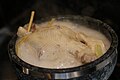 Samgye-tang
 -
 Samgye-tang
 -
 Samgye-tang


