Mulukhiyah: Difference between revisions
CSV import |
CSV import |
||
| Line 20: | Line 20: | ||
[[Category:Arab cuisine]] | [[Category:Arab cuisine]] | ||
{{food-stub}} | {{food-stub}} | ||
== Mulukhiyah == | |||
<gallery> | |||
File:Corchorus olitorius (1459401640).jpg|Mulukhiyah | |||
File:Corchorus colitorius saluyot leaves.jpg|Mulukhiyah | |||
File:Molokhia.JPG|Mulukhiyah | |||
File:Molokhia 2.JPG|Mulukhiyah | |||
File:Molokheya hi res.JPG|Mulukhiyah | |||
File:Syrian Mlokhia.jpg|Mulukhiyah | |||
File:ملوخية تونسية.JPG|Mulukhiyah | |||
File:Muluchiya pflanze2020.jpg|Mulukhiyah | |||
</gallery> | |||
Latest revision as of 00:55, 20 February 2025
Mulukhiyah is a popular dish in the Middle East and North Africa, particularly in Egypt, Lebanon, Syria, Jordan, Palestine, and Tunisia. It is a type of soup made from the leaves of the Corchorus species, which are known as "Jew's mallow" or "mallow leaves" in English. The name "Mulukhiyah" is derived from the Arabic word "Mulk", which means "to rule", and "hiyah", which means "life".
History[edit]
The origins of Mulukhiyah are believed to date back to ancient Egypt. It was a popular dish among the pharaohs and was considered a symbol of life and fertility. The dish was later adopted by the Arabs and spread throughout the Middle East and North Africa.
Preparation[edit]
Mulukhiyah is typically prepared by boiling the mallow leaves in a broth, often made from chicken, beef, or lamb. The leaves are then finely chopped and mixed with garlic and coriander. The dish is usually served with rice or bread, and is often accompanied by a side of pickles or salad.
Variations[edit]
There are many variations of Mulukhiyah across different regions. In Egypt, the dish is often made with rabbit or chicken, while in Lebanon and Syria, it is typically made with beef or lamb. In Jordan and Palestine, Mulukhiyah is often served with a side of yogurt or tahini sauce.
Nutritional Value[edit]
Mulukhiyah is rich in vitamins and minerals, including vitamin C, calcium, iron, and potassium. It is also a good source of dietary fiber.
Cultural Significance[edit]
Mulukhiyah is not just a dish, but also a part of the cultural heritage of the Middle East and North Africa. It is often served during special occasions and family gatherings, and is considered a symbol of hospitality and generosity.

Mulukhiyah[edit]
-
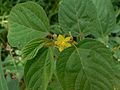 Mulukhiyah
 -
 Mulukhiyah
 -
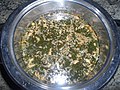 Mulukhiyah
 -
 Mulukhiyah
 -
 Mulukhiyah
 -
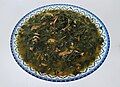 Mulukhiyah
 -
 Mulukhiyah
 -
 Mulukhiyah
.jpg)


