Customs and etiquette in Japanese dining: Difference between revisions
CSV import |
CSV import |
||
| Line 39: | Line 39: | ||
{{Etiquette}} | {{Etiquette}} | ||
{{food-stub}} | {{food-stub}} | ||
<gallery> | |||
File:Restaurant,_Roppongi,_Tokyo,_Japan_1_(133461680).jpg|Restaurant, Roppongi, Tokyo, Japan | |||
File:Chopstick.JPG|Chopstick | |||
File:一風堂_-_IPPUDO_2011_(5478792092).jpg|IPPUDO 2011 | |||
File:Oshibori,_Toritcho,_Montparnasse,_Paris_001.jpg|Oshibori, Toritcho, Montparnasse, Paris | |||
File:Gokannoge.jpg|Customs and etiquette in Japanese dining | |||
File:Tuna_ramen_noodle_(26144778614).jpg|Tuna ramen noodle | |||
File:Sushi_Fly_-_December_2018_-_Stierch_02.jpg|Sushi Fly | |||
File:Home_made_Bento.jpg|Home made Bento | |||
</gallery> | |||
Latest revision as of 21:43, 20 February 2025
Customs and Etiquette in Japanese Dining
Japanese dining customs and etiquette are deeply rooted in the country's history and culture. They are an integral part of the Japanese cuisine experience and are considered as important as the food itself.
Overview[edit]
The customs and etiquette in Japanese dining are a reflection of the Japanese culture's emphasis on harmony, respect, and humility. They are designed to show appreciation to the host, the chef, and the food. These customs are observed not only in formal dining settings but also in everyday meals at home.
Seating Arrangement[edit]
The traditional Japanese seating arrangement is on tatami mats around a low table. The most honored guest is usually seated farthest from the entrance. In formal settings, the host sits nearest to the entrance to attend to the guests' needs.
Eating Utensils[edit]
The primary eating utensils are chopsticks. There are specific rules for handling chopsticks, such as not pointing them at others, not passing food from chopstick to chopstick, and not sticking them upright in a bowl of rice.
Food Presentation[edit]
Food presentation is an essential aspect of Japanese dining. Dishes are often served in small portions, arranged aesthetically on a tray or a platter. The colors, textures, and even the dishes and bowls used are carefully chosen to enhance the overall dining experience.
Drinking Etiquette[edit]
Drinking etiquette is also an important part of Japanese dining customs. When drinking sake, it is customary to serve others before filling one's own cup. It is also considered polite to accept a drink when offered, even if it is just a small amount.
Meal Ending[edit]
At the end of the meal, it is customary to say "Gochisousama deshita," which expresses gratitude to the person who prepared the meal. It is also common to return all dishes and utensils to their original positions.
See Also[edit]
| Japanese cuisine 日本料理 |
|---|
|
|
| Etiquette | ||||||||
|---|---|---|---|---|---|---|---|---|
This etiquette-related article is a stub.
|

-
 Restaurant, Roppongi, Tokyo, Japan
 -
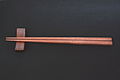 Chopstick
 -
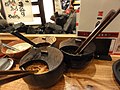 IPPUDO 2011
 -
 Oshibori, Toritcho, Montparnasse, Paris
 -
 Customs and etiquette in Japanese dining
 -
 Tuna ramen noodle
 -
 Sushi Fly
 -
 Home made Bento
.jpg)

.jpg)


.jpg)


