Laevistrombus canarium: Difference between revisions
CSV import |
CSV import |
||
| Line 28: | Line 28: | ||
{{mollusc-stub}} | {{mollusc-stub}} | ||
{{food-stub}} | {{food-stub}} | ||
== Laevistrombus canarium == | |||
<gallery> | |||
File:Strombus-canarium-001.jpg|Laevistrombus canarium shell | |||
File:Strombus_canarium_Anatomy_Tryon.jpg|Anatomy of Laevistrombus canarium | |||
File:Textile_cone.JPG|Laevistrombus canarium | |||
File:Tributyltin_oxide.png|Laevistrombus canarium | |||
</gallery> | |||
Latest revision as of 05:03, 18 February 2025
Laevistrombus canarium is a species of sea snail, a marine gastropod mollusk in the family Strombidae, the true conchs. It is also commonly known as the dog conch or dog whelk.
Description[edit]
The shell size of Laevistrombus canarium varies between 30 mm and 80 mm. The shell is robust and has a pointed spire. The aperture is large and the outer lip is thickened and reflected. The operculum has a long, curved, pointed spur on its outer edge. The color of the shell is variable, but it is usually white or cream with brown bands and zigzag lines or spots.
Distribution[edit]
Laevistrombus canarium is found in the Indo-Pacific region, from India to Melanesia, north to the Philippines, and south to Australia. It is also found in the South China Sea and the Gulf of Thailand.
Habitat[edit]
This species lives in sandy or muddy substrates in shallow water, usually not deeper than 20 m. It is often found in mangrove forests and seagrass meadows.
Human use[edit]
Laevistrombus canarium is an important food source in several Asian countries, especially in Malaysia, Thailand, and the Philippines. It is also used in traditional medicine and as a decorative item.
Conservation[edit]
Overfishing and habitat destruction are the main threats to Laevistrombus canarium. It is not currently considered endangered, but its population is declining in some areas.
References[edit]
<references />
See also[edit]


Laevistrombus canarium[edit]
-
 Laevistrombus canarium shell
 -
 Anatomy of Laevistrombus canarium
 -
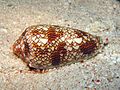 Laevistrombus canarium
 -
 Laevistrombus canarium


