Kaiseki: Difference between revisions
CSV import Tags: mobile edit mobile web edit |
CSV import Tags: mobile edit mobile web edit |
||
| Line 29: | Line 29: | ||
{{Haute cuisine}} | {{Haute cuisine}} | ||
{{food-stub}} | {{food-stub}} | ||
<gallery> | |||
File:Jisaku_Kaiseki_Ryori_01.jpg|Kaiseki | |||
File:Jisaku_Kaiseki_Ryori_04.jpg|Kaiseki | |||
File:Kaiseki_Kai_Tsugaru_Owani_Onsen_Aomori_pref_Japan01s.jpg|Kaiseki | |||
File:Kaiseki_Kai_Tsugaru_Owani_Onsen_Aomori_pref_Japan02s.jpg|Kaiseki | |||
File:Kaiseki_Kai_Tsugaru_Owani_Onsen_Aomori_pref_Japan03s.jpg|Kaiseki | |||
File:Kaiseki_Kai_Tsugaru_Owani_Onsen_Aomori_pref_Japan04s.jpg|Kaiseki | |||
File:Kaiseki_Kai_Tsugaru_Owani_Onsen_Aomori_pref_Japan05s.jpg|Kaiseki | |||
File:Kaiseki_Kai_Tsugaru_Owani_Onsen_Aomori_pref_Japan06s.jpg|Kaiseki | |||
File:Kaiseki_Kai_Tsugaru_Owani_Onsen_Aomori_pref_Japan07-2s.jpg|Kaiseki | |||
File:Kaiseki_Kai_Tsugaru_Owani_Onsen_Aomori_pref_Japan08s.jpg|Kaiseki | |||
File:Kaiseki_Kai_Tsugaru_Owani_Onsen_Aomori_pref_Japan09s.jpg|Kaiseki | |||
File:Fuyoen99st3200.jpg|Kaiseki | |||
</gallery> | |||
Latest revision as of 12:24, 18 February 2025
Kaiseki is a traditional multi-course Japanese dinner. The term also refers to the collection of skills and techniques that allow the preparation of such meals, and is analogous to Western haute cuisine.
Origins[edit]
Kaiseki has its origins in the Japanese tea ceremony, but has now evolved into an elaborate dining style showcasing the artistry and culinary skill of the chef. The term "kaiseki" can be written in two ways, each with a different meaning: the first, written as "会席", refers to a banquet meal with sake, while the second, written as "懐石", refers to the simple meal served in the tea ceremony.
Structure[edit]
A traditional kaiseki meal includes an appetizer, a sashimi course, a simmered dish, a grilled dish, and a steamed course. The meal concludes with a shokuji set, which includes a small serving of rice, miso soup, and pickles. The dishes are served in a specific order, each designed to highlight the natural flavors of the ingredients.
Ingredients and Preparation[edit]
The ingredients used in kaiseki cuisine are often seasonal, with an emphasis on locally sourced products. The preparation methods are designed to enhance the taste and appearance of each ingredient. The dishes are carefully presented, often using real leaves and flowers, and each dish is served on individual plates.
Cultural Significance[edit]
Kaiseki is more than just a meal; it is a form of art that reflects the Japanese culture and tradition. It embodies the Japanese aesthetic principles of wabi (transient and stark beauty), sabi (the beauty of natural aging), and yūgen (subtle and profound grace).
See Also[edit]
| Japanese cuisine 日本料理 |
|---|
|
|
| Haute cuisine | ||||||||||
|---|---|---|---|---|---|---|---|---|---|---|
This haute cuisine-related article is a stub.
|

-
 Kaiseki
 -
 Kaiseki
 -
 Kaiseki
 -
 Kaiseki
 -
 Kaiseki
 -
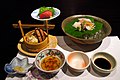 Kaiseki
 -
 Kaiseki
 -
 Kaiseki
 -
 Kaiseki
 -
 Kaiseki
 -
 Kaiseki
 -
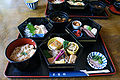 Kaiseki


