Hermetia illucens: Difference between revisions
CSV import |
CSV import |
||
| Line 30: | Line 30: | ||
{{Insect-stub}} | {{Insect-stub}} | ||
{{food-stub}} | {{food-stub}} | ||
== Hermetia illucens == | |||
<gallery> | |||
File:A_black_soldier_fly_(Hermetia_illucens)_on_a_crape_jasmime_leaf.jpg|A black soldier fly (Hermetia illucens) on a crape jasmine leaf | |||
File:Stratiomyidae_-_Hermetia_illucens.JPG|Hermetia illucens | |||
File:Hermetiaillucens.jpg|Hermetia illucens | |||
File:Black_soldier_flies_mating.jpg|Black soldier flies mating | |||
File:Black_soldier_fly_depositing_eggs_in_cardboard.jpg|Black soldier fly depositing eggs in cardboard | |||
File:Black-soldier-fly-depositing-eggs-in-wormfarm.jpg|Black soldier fly depositing eggs in worm farm | |||
File:Black_soldier_fly_inflating_wings.jpg|Black soldier fly inflating wings | |||
File:Bsffeeding.jpg|Hermetia illucens | |||
</gallery> | |||
Latest revision as of 11:03, 18 February 2025
Hermetia illucens, commonly known as the Black Soldier Fly (BSF), is a species of fly in the family Stratiomyidae. It is native to the Americas but has been introduced to many other regions worldwide, including Europe, Africa, the Middle East, and Asia.
Description[edit]
The adult Hermetia illucens is a medium-sized fly, measuring approximately 15-20mm in length. It is predominantly black in color, with a metallic blue or green sheen. The larvae, which are the most economically important stage of the insect's life cycle, are cream-colored and can reach up to 27mm in length.
Distribution and Habitat[edit]
Hermetia illucens is native to the Americas, but has been introduced to many other regions worldwide, including Europe, Africa, the Middle East, and Asia. It is highly adaptable and can be found in a wide range of habitats, from agricultural fields to urban areas.
Life Cycle[edit]
The life cycle of Hermetia illucens consists of four stages: egg, larva, pupa, and adult. The female lays her eggs in decaying organic matter, where the larvae feed and grow. After approximately two weeks, the larvae pupate and emerge as adults.
Economic Importance[edit]
Hermetia illucens is of significant economic importance due to its use in waste management and as a source of animal feed. The larvae are voracious feeders and can consume a wide range of organic waste, making them useful in waste management systems. Additionally, the larvae are high in protein and can be used as a sustainable source of animal feed.
Research and Applications[edit]
Research into the use of Hermetia illucens in waste management and animal feed production is ongoing. The insect's ability to convert waste into valuable protein makes it a promising tool for sustainable agriculture and waste management.
See Also[edit]
References[edit]
<references />


Hermetia illucens[edit]
-
 A black soldier fly (Hermetia illucens) on a crape jasmine leaf
 -
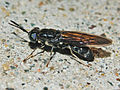 Hermetia illucens
 -
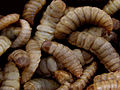 Hermetia illucens
 -
 Black soldier flies mating
 -
 Black soldier fly depositing eggs in cardboard
 -
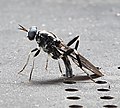 Black soldier fly depositing eggs in worm farm
 -
 Black soldier fly inflating wings
 -
 Hermetia illucens
_on_a_crape_jasmime_leaf.jpg)


