Jeonbok-juk: Difference between revisions
CSV import Tags: mobile edit mobile web edit |
CSV import |
||
| Line 18: | Line 18: | ||
{{Korea-food-stub}} | {{Korea-food-stub}} | ||
{{food-stub}} | {{food-stub}} | ||
== Jeonbok-juk == | |||
<gallery> | |||
File:Korean_abalone_porridge-Jeonbokjuk-02.jpg|Jeonbok-juk | |||
File:Korean_abalone_porridge-Jeonbokjuk-01A.jpg|Jeonbok-juk | |||
</gallery> | |||
Latest revision as of 01:55, 18 February 2025
Jeonbok-juk is a traditional Korean dish, specifically a type of juk, or porridge, made primarily from abalone and rice. It is considered a high-quality, nutritious dish often served to those who are ill or recovering from illness.
History[edit]
The history of Jeonbok-juk dates back to the Joseon Dynasty, where it was considered a dish of the royal court. The abalone used in the dish was often sourced from the coastal regions of the Korean peninsula, particularly Jeju Island.
Preparation[edit]
To prepare Jeonbok-juk, the abalone is first cleaned and its viscera removed. The abalone is then simmered with rice until the grains are fully cooked and the mixture has a creamy consistency. The dish is typically seasoned with soy sauce, sesame oil, and salt, and garnished with chopped scallions.
Cultural Significance[edit]
Jeonbok-juk is often served during the Korean New Year and other special occasions. It is also a popular dish in Korean royal court cuisine. The dish is believed to have restorative properties and is often served to those recovering from illness or surgery.
Health Benefits[edit]
Abalone, the primary ingredient in Jeonbok-juk, is rich in protein and essential amino acids. It also contains a variety of vitamins and minerals, including Vitamin B12, Vitamin E, and iodine. The dish is also low in fat, making it a healthy choice for those on a diet or watching their cholesterol levels.

Jeonbok-juk[edit]
-
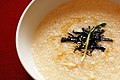 Jeonbok-juk
 -
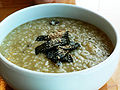 Jeonbok-juk


