Knödel: Difference between revisions
CSV import Tags: mobile edit mobile web edit |
CSV import |
||
| Line 33: | Line 33: | ||
[[Category:Dumplings]] | [[Category:Dumplings]] | ||
{{food-stub}} | {{food-stub}} | ||
<gallery> | |||
File:Knödelschneemänner_1.jpg|Knödel | |||
File:Pečené_hovězí_maso,_houskové_knedlíky.jpg|Roast beef with bread dumplings | |||
File:2011_0628_Seefeld_Schweinsbraten_mit_Kartoffelknödel.jpg|Pork roast with potato dumplings | |||
File:Plum_Dumpling.jpg|Plum Dumpling | |||
File:Hungarian_túrógombóc.jpg|Hungarian túrógombóc | |||
File:Leberknoedelsuppe.jpg|Liver dumpling soup | |||
File:Serviettenkloss.jpg|Serviettenkloss | |||
File:Speckknodel.jpg|Speckknödel | |||
File:2015_0731_Tiroler_Käseknödelsuppe_Edelweisshütte_Sölden.jpg|Tyrolean cheese dumpling soup | |||
</gallery> | |||
Latest revision as of 12:01, 18 February 2025
Knödel (or dumpling in English) is a traditional food staple in various regions across Europe, particularly in Germany, Austria, and the Czech Republic. It is a type of dumpling that is often served as a side dish with meat but can also be a dessert or a main dish itself.
History[edit]
The origin of Knödel is believed to be in the Middle Ages when food was often scarce. The dumpling was a way to make use of leftover bread or potatoes, and it quickly became a staple in the diet of many European households.
Preparation[edit]
Knödel is typically made from a dough that can include ingredients such as bread, potatoes, flour, eggs, and milk. The dough is then shaped into balls and boiled in water or broth until they are cooked through. There are many variations of Knödel, including those that are filled with meats, fruits, or sweets.
Varieties[edit]
There are numerous varieties of Knödel, each with its unique ingredients and preparation methods. Some of the most popular include:
- Semmelknödel: This is a bread dumpling that is often served with meat dishes.
- Kartoffelknödel: A potato dumpling that is a common side dish in German cuisine.
- Marillenknödel: A sweet dumpling filled with apricots and often served as a dessert in Austria.
Cultural Significance[edit]
Knödel plays a significant role in many cultural traditions and festivities in Europe. For example, in Austria, it is common to have Knödel at Christmas dinner. In Germany, Kartoffelknödel is a traditional dish served at Oktoberfest.
See Also[edit]

-
 Knödel
 -
 Roast beef with bread dumplings
 -
 Pork roast with potato dumplings
 -
 Plum Dumpling
 -
 Hungarian túrógombóc
 -
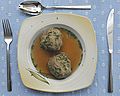 Liver dumpling soup
 -
 Serviettenkloss
 -
 Speckknödel
 -
 Tyrolean cheese dumpling soup


