Butter churning in Nepal: Difference between revisions
CSV import Tags: mobile edit mobile web edit |
CSV import |
||
| Line 21: | Line 21: | ||
{{Nepal-stub}} | {{Nepal-stub}} | ||
{{food-stub}} | {{food-stub}} | ||
<gallery> | |||
File:A_setup_for_Churning_Butter.jpg|A setup for Churning Butter | |||
File:Addition_of_hot_water_during_butter_churning.jpg|Addition of hot water during butter churning | |||
File:A_woman_extracting_butter.jpg|A woman extracting butter | |||
File:Theki2.jpg|Butter churning in Nepal | |||
</gallery> | |||
Latest revision as of 21:26, 20 February 2025
Butter Churning in Nepal is a traditional practice that has been carried out for centuries. It is an integral part of the Nepalese culture and economy, particularly in rural areas where dairy farming is prevalent.
History[edit]
The history of butter churning in Nepal dates back to the ancient times when the country was primarily agrarian. The practice has been passed down through generations and is still prevalent in many parts of the country. The traditional method of butter churning, known as Dhiki, involves the use of a wooden plunger to churn milk in a large pot.
Process[edit]
The process of butter churning in Nepal begins with the collection of milk from cows or yaks. The milk is then left to ferment for a period of time, usually overnight. The fermented milk, or curd, is then churned using a traditional wooden churner. The churning process separates the butterfat from the milk, resulting in butter and buttermilk. The butter is then collected and stored for use, while the buttermilk is often consumed as a beverage or used in cooking.
Cultural Significance[edit]
Butter churning in Nepal has significant cultural and religious importance. Butter is used in various religious rituals and ceremonies, such as the Tihar festival, where it is used to light lamps. It is also a staple in the Nepalese diet and is used in a variety of dishes, including the traditional Nepalese dish, Dal Bhat.
Economic Importance[edit]
In addition to its cultural significance, butter churning also plays a crucial role in the Nepalese economy. Many rural families rely on the sale of butter and other dairy products as a source of income. Moreover, the practice of butter churning also contributes to the country's agriculture sector, which is a major part of Nepal's economy.
Challenges and Future[edit]
Despite its importance, the practice of butter churning in Nepal faces several challenges. These include the increasing urbanization and modernization of the country, which has led to a decline in traditional farming practices. However, efforts are being made to preserve this traditional practice and promote it as a sustainable source of income for rural communities.


-
 A setup for Churning Butter
 -
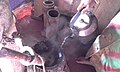 Addition of hot water during butter churning
 -
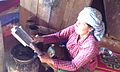 A woman extracting butter
 -
 Butter churning in Nepal


