Curing salt: Difference between revisions
CSV import Tags: mobile edit mobile web edit |
CSV import |
||
| Line 23: | Line 23: | ||
[[Category:Food ingredients]] | [[Category:Food ingredients]] | ||
{{food-stub}} | {{food-stub}} | ||
<gallery> | |||
File:Prague_powder_No_1.jpg|Prague powder No. 1 | |||
</gallery> | |||
Latest revision as of 21:22, 20 February 2025
Curing salt is a type of salt used in the preservation of foods, particularly meat and fish. It is also known as "pink salt" due to its pink color, which is added to distinguish it from regular table salt.
History[edit]
The use of curing salt dates back to ancient times when it was used to preserve meat and fish. The Ancient Egyptians were known to use salt for preservation, and the practice spread throughout the world over time. The pink color was added in the 20th century to prevent confusion with regular table salt.
Composition[edit]
Curing salt is composed of regular table salt and a small amount of sodium nitrite, which serves to inhibit the growth of bacteria, specifically Clostridium botulinum, the bacteria responsible for botulism. Some types of curing salt also contain sodium nitrate, which breaks down into sodium nitrite over time.
Uses[edit]
Curing salt is used in the preservation of meats and fish. It gives these foods their characteristic pink color and tangy flavor. It is also used in the production of sausages, ham, bacon, corned beef, and other cured meats.
Safety[edit]
While curing salt is safe to use in food preservation, it should be used sparingly and according to the instructions. Overconsumption of sodium nitrite can lead to health problems, including methemoglobinemia, a condition that affects the body's ability to carry oxygen.
See also[edit]

-
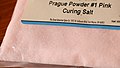 Prague powder No. 1

