Triceps surae muscle: Difference between revisions
CSV import |
CSV import |
||
| Line 1: | Line 1: | ||
{{Short description|Muscle group in the calf of the leg}} | |||
{{Use dmy dates|date=October 2023}} | |||
The '''triceps surae''' is a pair of muscles located at the back of the lower leg, commonly referred to as the calf. It is composed of the [[gastrocnemius muscle]] and the [[soleus muscle]]. These muscles are crucial for movements such as walking, running, and jumping. | |||
The triceps surae | |||
==Anatomy== | |||
The triceps surae is made up of two major muscles: | |||
===Gastrocnemius=== | |||
The [[gastrocnemius muscle]] is the larger and more superficial of the two muscles. It has two heads, the medial and lateral, which originate from the femur. The gastrocnemius crosses both the knee and ankle joints, contributing to its role in knee flexion and plantarflexion of the foot. | |||
===Soleus=== | |||
The [[soleus muscle]] lies beneath the gastrocnemius. It originates from the tibia and fibula and does not cross the knee joint. The soleus is primarily responsible for plantarflexion of the foot and is active during standing and walking. | |||
==Function== | ==Function== | ||
The triceps surae is | The primary function of the triceps surae is to facilitate plantarflexion of the foot at the ankle joint. This action is essential for pushing the body forward during walking and running. The gastrocnemius also assists in knee flexion due to its attachment above the knee joint. | ||
== | ==Innervation== | ||
The triceps surae is innervated by the [[tibial nerve]], which is a branch of the [[sciatic nerve]]. This nerve provides the necessary signals for muscle contraction and coordination. | |||
== | ==Blood Supply== | ||
* [[ | The blood supply to the triceps surae is primarily provided by the [[posterior tibial artery]] and its branches. Adequate blood flow is essential for muscle function and recovery. | ||
==Clinical Significance== | |||
Injuries to the triceps surae, such as strains or tears, are common in athletes and can result from overuse or sudden movements. Conditions like [[Achilles tendinitis]] can also affect the function of these muscles. | |||
==Related pages== | |||
* [[Gastrocnemius muscle]] | |||
* [[Soleus muscle]] | |||
* [[Achilles tendon]] | * [[Achilles tendon]] | ||
==Gallery== | |||
<gallery> | |||
File:Triceps_surae.svg|Diagram of the triceps surae | |||
File:Triceps_surae_by_Majid_Doroudi.webm|Video of triceps surae function | |||
File:Triceps_surae_-_animation.gif|Animation of triceps surae movement | |||
File:Sobo_1909_303.png|Illustration of the gastrocnemius | |||
File:Sobo_1909_304.png|Illustration of the soleus | |||
File:Sobo_1909_579-580.png|Detailed anatomy of the calf muscles | |||
File:Braus_1921_293.png|Historical anatomy illustration | |||
File:Sobo_1909_720.png|Cross-section of the lower leg | |||
</gallery> | |||
==References== | ==References== | ||
* Gray, Henry. ''Gray's Anatomy: The Anatomical Basis of Clinical Practice''. 41st edition. Elsevier. | |||
* Moore, Keith L., et al. ''Clinically Oriented Anatomy''. 7th edition. Lippincott Williams & Wilkins. | |||
[[Category:Muscles of the lower limb]] | [[Category:Muscles of the lower limb]] | ||
Latest revision as of 00:41, 10 February 2025
Muscle group in the calf of the leg
The triceps surae is a pair of muscles located at the back of the lower leg, commonly referred to as the calf. It is composed of the gastrocnemius muscle and the soleus muscle. These muscles are crucial for movements such as walking, running, and jumping.
Anatomy[edit]
The triceps surae is made up of two major muscles:
Gastrocnemius[edit]
The gastrocnemius muscle is the larger and more superficial of the two muscles. It has two heads, the medial and lateral, which originate from the femur. The gastrocnemius crosses both the knee and ankle joints, contributing to its role in knee flexion and plantarflexion of the foot.
Soleus[edit]
The soleus muscle lies beneath the gastrocnemius. It originates from the tibia and fibula and does not cross the knee joint. The soleus is primarily responsible for plantarflexion of the foot and is active during standing and walking.
Function[edit]
The primary function of the triceps surae is to facilitate plantarflexion of the foot at the ankle joint. This action is essential for pushing the body forward during walking and running. The gastrocnemius also assists in knee flexion due to its attachment above the knee joint.
Innervation[edit]
The triceps surae is innervated by the tibial nerve, which is a branch of the sciatic nerve. This nerve provides the necessary signals for muscle contraction and coordination.
Blood Supply[edit]
The blood supply to the triceps surae is primarily provided by the posterior tibial artery and its branches. Adequate blood flow is essential for muscle function and recovery.
Clinical Significance[edit]
Injuries to the triceps surae, such as strains or tears, are common in athletes and can result from overuse or sudden movements. Conditions like Achilles tendinitis can also affect the function of these muscles.
Related pages[edit]
Gallery[edit]
-
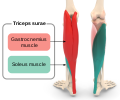 Diagram of the triceps surae
 -
 Video of triceps surae function
 -
 Animation of triceps surae movement
 -
 Illustration of the gastrocnemius
 -
 Illustration of the soleus
 -
 Detailed anatomy of the calf muscles
 -
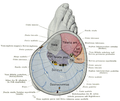 Historical anatomy illustration
 -
 Cross-section of the lower leg


References[edit]
- Gray, Henry. Gray's Anatomy: The Anatomical Basis of Clinical Practice. 41st edition. Elsevier.
- Moore, Keith L., et al. Clinically Oriented Anatomy. 7th edition. Lippincott Williams & Wilkins.
