Tsunami: Difference between revisions
CSV import |
CSV import |
||
| Line 1: | Line 1: | ||
''' | ==Tsunami== | ||
A '''tsunami''' is a series of waves in a water body caused by the displacement of a large volume of water, generally in an ocean or a large lake. Earthquakes, volcanic eruptions, and other underwater explosions (including detonations, landslides, glacier calvings, meteorite impacts, and other disturbances above or below water) all have the potential to generate a tsunami. Unlike normal ocean waves, which are generated by wind or tides, a tsunami is characterized by its long wavelength, which can be hundreds of kilometers long. | |||
==Etymology== | ==Etymology== | ||
The term | The term "tsunami" is a Japanese word, with the characters _ (tsu) meaning "harbor" and _ (nami) meaning "wave." The term was adopted into English to describe the phenomenon of large sea waves caused by underwater seismic activity. | ||
== | ==Causes== | ||
Tsunamis are | Tsunamis are primarily caused by [[underwater earthquakes]], which occur when tectonic plates shift abruptly and displace the water above. Other causes include volcanic eruptions, underwater landslides, and meteorite impacts. The sudden displacement of water generates waves that travel across the ocean at high speeds. | ||
==Characteristics== | ==Characteristics== | ||
Tsunamis have a small wave height offshore, and a very long wavelength (often hundreds of kilometers long), which is why they generally pass unnoticed at sea, forming only a slight swell usually about 300 millimeters (12 in) above the normal sea surface. As the tsunami approaches land, the wave height increases dramatically. | |||
==Historical Tsunamis== | |||
One of the most devastating tsunamis in recorded history occurred on December 26, 2004, in the Indian Ocean. Triggered by a massive undersea earthquake off the coast of Sumatra, Indonesia, the tsunami affected 14 countries and resulted in over 230,000 deaths. Another significant event was the 1755 [[Lisbon earthquake]], which generated a tsunami that struck the coasts of Portugal, Spain, and North Africa. | |||
==Detection and Warning Systems== | |||
Modern [[tsunami warning systems]] use a combination of seismic data and sea-level monitoring to detect tsunamis. These systems are designed to provide early warnings to coastal areas, allowing for evacuation and other safety measures to be implemented. | |||
== | ==Mitigation and Preparedness== | ||
Coastal communities in tsunami-prone areas often have evacuation routes and signage to guide residents to higher ground. Structures such as tsunami walls are also constructed to protect against the impact of waves. | |||
== | ==Related Pages== | ||
* [[Earthquake]] | * [[Earthquake]] | ||
* [[Volcanic eruption]] | |||
* [[Seismic wave]] | * [[Seismic wave]] | ||
* [[Tsunami warning system | * [[Tectonic plate]] | ||
==References== | |||
* National Oceanic and Atmospheric Administration (NOAA). "Tsunami." Retrieved from [https://www.noaa.gov/tsunami] | |||
* United States Geological Survey (USGS). "Tsunami and Earthquake Research." Retrieved from [https://www.usgs.gov/natural-hazards/earthquake-hazards/tsunamis] | |||
==Gallery== | |||
<gallery> | |||
File:2004-tsunami.jpg|2004 Indian Ocean tsunami | |||
File:NOAA_Tsunami_Animation-2016.webm|Animation of tsunami propagation | |||
File:Tsunami_2004_aftermath._Aceh,_Indonesia,_2005._Photo-_AusAID_(10730863873).jpg|Aftermath in Aceh, Indonesia | |||
File:1755_Lisbon_earthquake.jpg|1755 Lisbon earthquake and tsunami | |||
File:Eq-gen1.svg|Diagram of tsunami generation | |||
File:Eq-gen2.svg|Diagram of tsunami propagation | |||
File:Eq-gen3.svg|Diagram of tsunami impact | |||
File:Eq-gen4.svg|Diagram of tsunami run-up | |||
File:Tsunami4.JPG|Tsunami wave | |||
File:Tsunami3.JPG|Tsunami impact | |||
File:Tsunami5.JPG|Tsunami aftermath | |||
File:Propagation_du_tsunami_en_profondeur_variable.gif|Tsunami propagation in variable depth | |||
File:Tsunami2.JPG|Tsunami wave | |||
File:Shallow_water_wave.gif|Shallow water wave | |||
File:Tsunami_run-up,_height,_and_inundation.png|Tsunami run-up and inundation | |||
File:Calculated_Travel_Time_Map_for_1964_Alaska_Tsunami.jpg|Travel time map for 1964 Alaska tsunami | |||
File:Bamfield_Tsunami_Hazard_Zone_sign.jpg|Tsunami hazard zone sign | |||
File:A_tsunami_warning_sign_in_Kamakura,_Japan.jpg|Tsunami warning sign in Japan | |||
File:Zona_de_Inundabilidad.jpg|Inundation zone sign | |||
File:Tsunami_Evacuation_Route_signage_south_of_Aberdeen_Washington.jpg|Tsunami evacuation route sign | |||
File:Dart_tsunamicover.jpg|DART tsunami detection system | |||
File:Tsunami_wall.jpg|Tsunami wall | |||
</gallery> | |||
[[Category:Natural disasters]] | [[Category:Natural disasters]] | ||
[[Category: | [[Category:Oceanography]] | ||
Latest revision as of 01:16, 10 February 2025
Tsunami[edit]
A tsunami is a series of waves in a water body caused by the displacement of a large volume of water, generally in an ocean or a large lake. Earthquakes, volcanic eruptions, and other underwater explosions (including detonations, landslides, glacier calvings, meteorite impacts, and other disturbances above or below water) all have the potential to generate a tsunami. Unlike normal ocean waves, which are generated by wind or tides, a tsunami is characterized by its long wavelength, which can be hundreds of kilometers long.
Etymology[edit]
The term "tsunami" is a Japanese word, with the characters _ (tsu) meaning "harbor" and _ (nami) meaning "wave." The term was adopted into English to describe the phenomenon of large sea waves caused by underwater seismic activity.
Causes[edit]
Tsunamis are primarily caused by underwater earthquakes, which occur when tectonic plates shift abruptly and displace the water above. Other causes include volcanic eruptions, underwater landslides, and meteorite impacts. The sudden displacement of water generates waves that travel across the ocean at high speeds.
Characteristics[edit]
Tsunamis have a small wave height offshore, and a very long wavelength (often hundreds of kilometers long), which is why they generally pass unnoticed at sea, forming only a slight swell usually about 300 millimeters (12 in) above the normal sea surface. As the tsunami approaches land, the wave height increases dramatically.
Historical Tsunamis[edit]
One of the most devastating tsunamis in recorded history occurred on December 26, 2004, in the Indian Ocean. Triggered by a massive undersea earthquake off the coast of Sumatra, Indonesia, the tsunami affected 14 countries and resulted in over 230,000 deaths. Another significant event was the 1755 Lisbon earthquake, which generated a tsunami that struck the coasts of Portugal, Spain, and North Africa.
Detection and Warning Systems[edit]
Modern tsunami warning systems use a combination of seismic data and sea-level monitoring to detect tsunamis. These systems are designed to provide early warnings to coastal areas, allowing for evacuation and other safety measures to be implemented.
Mitigation and Preparedness[edit]
Coastal communities in tsunami-prone areas often have evacuation routes and signage to guide residents to higher ground. Structures such as tsunami walls are also constructed to protect against the impact of waves.
Related Pages[edit]
References[edit]
- National Oceanic and Atmospheric Administration (NOAA). "Tsunami." Retrieved from [1]
- United States Geological Survey (USGS). "Tsunami and Earthquake Research." Retrieved from [2]
Gallery[edit]
-
 2004 Indian Ocean tsunami
 -
 Animation of tsunami propagation
 -
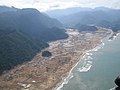 Aftermath in Aceh, Indonesia
 -
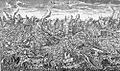 1755 Lisbon earthquake and tsunami
 -
 Diagram of tsunami generation
 -
 Diagram of tsunami propagation
 -
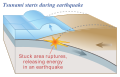 Diagram of tsunami impact
 -
 Diagram of tsunami run-up
 -
 Tsunami wave
 -
 Tsunami impact
 -
 Tsunami aftermath
 -
 Tsunami propagation in variable depth
 -
 Tsunami wave
 -
 Shallow water wave
 -
 Tsunami run-up and inundation
 -
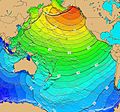 Travel time map for 1964 Alaska tsunami
 -
 Tsunami hazard zone sign
 -
 Tsunami warning sign in Japan
 -
 Inundation zone sign
 -
 Tsunami evacuation route sign
 -
 DART tsunami detection system
 -
 Tsunami wall

.jpg)


