Spinal anaesthesia: Difference between revisions
CSV import |
CSV import Tags: mobile edit mobile web edit |
||
| Line 23: | Line 23: | ||
{{stub}} | {{stub}} | ||
<gallery> | |||
File:Liquor_bei_Spinalanaesthesie.JPG|Spinal anaesthesia | |||
File:Prinzip_der_Spinalanaesthesie.png|Principle of spinal anaesthesia | |||
</gallery> | |||
Latest revision as of 02:12, 18 February 2025
Spinal Anaesthesia (or Spinal Anesthesia), also known as a spinal block, is a form of anaesthesia that involves the injection of a local anaesthetic into the subarachnoid space, a part of the spinal cord. This procedure is commonly used in surgeries of the lower abdomen, pelvis, rectum, perineum, and lower extremities.
Procedure[edit]
The procedure of spinal anaesthesia involves the insertion of a needle through several layers of tissue in the back until it reaches the subarachnoid space. A local anaesthetic is then injected, which numbs the lower half of the body. The patient remains awake and alert during the procedure, but does not feel any pain.
Uses[edit]
Spinal anaesthesia is commonly used in surgeries of the lower abdomen, pelvis, rectum, perineum, and lower extremities. It is also used in some diagnostic procedures, such as lumbar puncture.
Risks and Complications[edit]
Like all medical procedures, spinal anaesthesia carries some risks. These include headache, nausea, vomiting, low blood pressure, and nerve damage. In rare cases, serious complications such as paralysis or death can occur.
History[edit]
Spinal anaesthesia was first used in the late 19th century. It was initially used in obstetric procedures, but its use has since expanded to include a wide range of surgical procedures.
See Also[edit]
 | This medical article is a stub. You can help WikiMD by expanding the page. |
-
 Spinal anaesthesia
 -
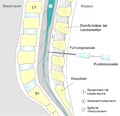 Principle of spinal anaesthesia


