Saponin: Difference between revisions
CSV import |
CSV import Tags: mobile edit mobile web edit |
||
| Line 23: | Line 23: | ||
{{stub}} | {{stub}} | ||
{{dictionary-stub1}} | {{dictionary-stub1}} | ||
<gallery> | |||
File:Solanine.svg|Solanine chemical structure | |||
</gallery> | |||
Latest revision as of 21:08, 23 February 2025
Saponin is a class of chemical compounds found in particular abundance in various plant species. More specifically, they are amphipathic glycosides grouped phenomenologically by the soap-like foaming they produce when shaken in aqueous solutions, and structurally by having one or more hydrophilic glycoside moieties combined with a lipophilic triterpene derivative.
Structure and biochemistry[edit]
Saponins are found in many plants and in the animal kingdom where they can be synthesized by pathogenic microorganisms and lower marine animals. They derive their name from the soapwort plant (the genus Saponaria, family Caryophyllaceae), the root of which was used historically as a soap. Saponins are indeed found in many plants, and derive their name from the soapwort plant (the genus Saponaria, family Caryophyllaceae), the root of which was used historically as a soap.
Uses[edit]
Saponins have historically been understood to be plant-derived, but they have also been isolated from marine organisms such as sea cucumber. Saponins are used in the commercial preparation of vaccines as an adjuvant to enhance the immune response to an antigen.
Health effects[edit]
Saponins have been recognized for their medicinal and remedial properties in traditional systems of medicine for centuries. They have been known to have anti-inflammatory and antioxidant properties. However, they can also have toxic effects, especially when consumed in large amounts.
See also[edit]
 |
 |
-
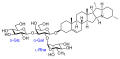 Solanine chemical structure


