Transpiration: Difference between revisions
CSV import Tags: mobile edit mobile web edit |
CSV import |
||
| (One intermediate revision by the same user not shown) | |||
| Line 1: | Line 1: | ||
== Transpiration == | |||
[[File:transpiration_Overview.svg|thumb|right|Overview of the transpiration process in plants.]] | |||
'''Transpiration''' is the process by which moisture is carried through plants from roots to small pores on the underside of leaves, where it changes to vapor and is released to the atmosphere. Transpiration is essentially evaporation of water from plant leaves. It is a crucial part of the water cycle and plays a significant role in the regulation of temperature and water balance in plants. | |||
== | == Mechanism == | ||
[[File:Transpiration_of_Water_in_Xylem.svg|thumb|right|Diagram showing the movement of water in the xylem during transpiration.]] | |||
Transpiration occurs mainly through small openings on the leaves called [[stomata]]. These openings are surrounded by guard cells that control their opening and closing. When stomata are open, water vapor escapes from the leaf into the atmosphere. This loss of water creates a negative pressure within the leaf, pulling more water up from the roots through the [[xylem]]. | |||
== Factors Affecting Transpiration == | |||
== | Several environmental factors influence the rate of transpiration: | ||
* [[ | === Light === | ||
* [[ | |||
Light stimulates the opening of stomata, increasing the rate of transpiration. During the day, when light is abundant, transpiration rates are generally higher. | |||
=== Temperature === | |||
[[File:Transpiration_Temperature_Graph.svg|thumb|right|Graph showing the effect of temperature on transpiration rate.]] | |||
Higher temperatures increase the rate of evaporation of water from leaf surfaces, thus increasing transpiration. Conversely, lower temperatures reduce the rate of transpiration. | |||
=== Humidity === | |||
[[File:Transpiration_Humidity_Graph.svg|thumb|right|Graph showing the effect of humidity on transpiration rate.]] | |||
High humidity levels decrease the rate of transpiration because the air is already saturated with moisture, reducing the gradient for water vapor to diffuse out of the leaf. | |||
=== Wind === | |||
[[File:Transpiration_WindVelocity_Graph.svg|thumb|right|Graph showing the effect of wind velocity on transpiration rate.]] | |||
Wind increases the rate of transpiration by removing the boundary layer of saturated air around the leaf, thus maintaining a high gradient for water vapor diffusion. | |||
== Importance of Transpiration == | |||
Transpiration serves several important functions in plants: | |||
* '''Cooling''': As water evaporates from the leaf surface, it cools the plant, similar to how sweating cools the human body. | |||
* '''Nutrient Transport''': Transpiration helps in the upward movement of water and dissolved minerals from the roots to the leaves. | |||
* '''Water Balance''': It maintains the water balance within the plant, preventing wilting. | |||
== Adaptations to Reduce Transpiration == | |||
[[File:Xerophyte.png|thumb|right|Xerophytes have adaptations to reduce water loss.]] | |||
Plants in arid environments have developed adaptations to minimize water loss. These include: | |||
* '''Thick Cuticles''': A waxy layer on leaves that reduces water loss. | |||
* '''Reduced Leaf Area''': Smaller leaves or spines reduce the surface area for transpiration. | |||
* '''Stomatal Closure''': Some plants can close their stomata during the hottest part of the day to conserve water. | |||
== Related Pages == | |||
* [[Evaporation]] | |||
* [[Photosynthesis]] | * [[Photosynthesis]] | ||
* [[Water cycle]] | |||
* [[Xerophyte]] | |||
== References == | |||
{{Reflist}} | |||
[[Category:Plant physiology]] | [[Category:Plant physiology]] | ||
[[Category:Water]] | [[Category:Water cycle]] | ||
<gallery> | |||
File:Transpiration_Overview.svg|Transpiration Overview | |||
File:Transpiration_of_Water_in_Xylem.svg|Transpiration of Water in Xylem | |||
File:Tomato_leaf_stomate_1-color.jpg|Tomato Leaf Stomate | |||
File:Afternoon_Clouds_over_the_Amazon_Rainforest.jpg|Afternoon Clouds over the Amazon Rainforest | |||
File:Transpiration_Temperature_Graph.svg|Transpiration Temperature Graph | |||
File:Transpiration_WindVelocity_Graph.svg|Transpiration Wind Velocity Graph | |||
File:Transpiration_Humidity_Graph.svg|Transpiration Humidity Graph | |||
File:Xerophyte.png|Xerophyte | |||
</gallery> | |||
Latest revision as of 11:37, 18 February 2025
Transpiration[edit]

Transpiration is the process by which moisture is carried through plants from roots to small pores on the underside of leaves, where it changes to vapor and is released to the atmosphere. Transpiration is essentially evaporation of water from plant leaves. It is a crucial part of the water cycle and plays a significant role in the regulation of temperature and water balance in plants.
Mechanism[edit]

Transpiration occurs mainly through small openings on the leaves called stomata. These openings are surrounded by guard cells that control their opening and closing. When stomata are open, water vapor escapes from the leaf into the atmosphere. This loss of water creates a negative pressure within the leaf, pulling more water up from the roots through the xylem.
Factors Affecting Transpiration[edit]
Several environmental factors influence the rate of transpiration:
Light[edit]
Light stimulates the opening of stomata, increasing the rate of transpiration. During the day, when light is abundant, transpiration rates are generally higher.
Temperature[edit]

Higher temperatures increase the rate of evaporation of water from leaf surfaces, thus increasing transpiration. Conversely, lower temperatures reduce the rate of transpiration.
Humidity[edit]

High humidity levels decrease the rate of transpiration because the air is already saturated with moisture, reducing the gradient for water vapor to diffuse out of the leaf.
Wind[edit]

Wind increases the rate of transpiration by removing the boundary layer of saturated air around the leaf, thus maintaining a high gradient for water vapor diffusion.
Importance of Transpiration[edit]
Transpiration serves several important functions in plants:
- Cooling: As water evaporates from the leaf surface, it cools the plant, similar to how sweating cools the human body.
- Nutrient Transport: Transpiration helps in the upward movement of water and dissolved minerals from the roots to the leaves.
- Water Balance: It maintains the water balance within the plant, preventing wilting.
Adaptations to Reduce Transpiration[edit]

Plants in arid environments have developed adaptations to minimize water loss. These include:
- Thick Cuticles: A waxy layer on leaves that reduces water loss.
- Reduced Leaf Area: Smaller leaves or spines reduce the surface area for transpiration.
- Stomatal Closure: Some plants can close their stomata during the hottest part of the day to conserve water.
Related Pages[edit]
References[edit]
<references group="" responsive="1"></references>
-
 Transpiration Overview
 -
 Transpiration of Water in Xylem
 -
 Tomato Leaf Stomate
 -
 Afternoon Clouds over the Amazon Rainforest
 -
 Transpiration Temperature Graph
 -
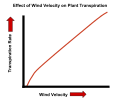 Transpiration Wind Velocity Graph
 -
 Transpiration Humidity Graph
 -
 Xerophyte


