Satellite: Difference between revisions
CSV import |
CSV import |
||
| Line 32: | Line 32: | ||
{{stub}} | {{stub}} | ||
== Satellite == | |||
<gallery> | |||
File:Two_3U_CubeSats.jpg|Two 3U CubeSats | |||
File:Sputnik_asm.jpg|Sputnik | |||
File:Ion_Engine_Test_Firing_-_GPN-2000-000482.jpg|Ion Engine Test Firing | |||
File:ISS-54_ELC-1,_main_solar_arrays_and_radiators_seen_from_the_Cupola.jpg|ISS-54 ELC-1, main solar arrays and radiators seen from the Cupola | |||
File:Earth_Radiation_Budget_Satellite.jpg|Earth Radiation Budget Satellite | |||
File:Hubble_Space_Telescope_(27946391011).jpg|Hubble Space Telescope | |||
File:The_growth_of_all_tracked_objects_in_space_over_time_(space_debris_and_satellites).png|The growth of all tracked objects in space over time (space debris and satellites) | |||
File:Space_capabilities_-_launch_and_satellite.png|Space capabilities - launch and satellite | |||
</gallery> | |||
Latest revision as of 21:19, 23 February 2025
Satellite is a celestial body that orbits around a planet. The term is often used to refer to artificial satellites, which are man-made objects launched into space for various purposes, including communication, weather monitoring, scientific research, and navigation. However, natural satellites, also known as moons, are also common in our solar system and beyond.
Natural Satellites[edit]
Natural satellites, or moons, are celestial bodies that orbit around a planet. They are formed from the same process that forms planets, through the accretion of dust and gas in the early solar system. The Earth has one natural satellite, the Moon, while other planets in our solar system have multiple moons. For example, Jupiter has 79 known moons, the largest of which are the four Galilean moons.
Artificial Satellites[edit]
Artificial satellites are man-made objects launched into space for various purposes. The first artificial satellite, Sputnik 1, was launched by the Soviet Union in 1957. Since then, thousands of satellites have been launched into orbit by countries and private companies around the world.
Communication Satellites[edit]
Communication satellites are used to relay and amplify radio telecommunications signals via a transponder. They create a communication channel between a source transmitter and a receiver at different locations on Earth.
Weather Satellites[edit]
Weather satellites are used to monitor Earth's weather and climate. They provide data for weather forecasting, climate research, and monitoring of natural disasters.
[edit]
Navigation satellites are used for global navigation systems like the Global Positioning System (GPS). They provide geolocation and time information to a GPS receiver anywhere on or near the Earth.
See Also[edit]
 | |
|---|---|
 |
 |
Satellite[edit]
-
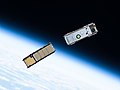 Two 3U CubeSats
 -
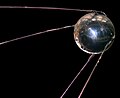 Sputnik
 -
 Ion Engine Test Firing
 -
 ISS-54 ELC-1, main solar arrays and radiators seen from the Cupola
 -
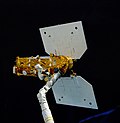 Earth Radiation Budget Satellite
 -
 Hubble Space Telescope
 -
 The growth of all tracked objects in space over time (space debris and satellites)
 -
 Space capabilities - launch and satellite


.jpg)
.png)

