Myxomatosis: Difference between revisions
CSV import |
CSV import |
||
| Line 24: | Line 24: | ||
{{stub}} | {{stub}} | ||
{{dictionary-stub1}} | {{dictionary-stub1}} | ||
== Myxomatosis == | |||
<gallery> | |||
File:Myxoma_virus_(transmission_electron_microscope).jpg|Myxoma virus (transmission electron microscope) | |||
File:Myxomatose_2.jpg|Myxomatose 2 | |||
File:Rabbit_with_Myxomatosis_1(RLH).jpg|Rabbit with Myxomatosis 1 (RLH) | |||
File:Myxomatosis_in_a_pet_rabbit.jpg|Myxomatosis in a pet rabbit | |||
File:20190828_Myxomatosis_MSW_strain.jpg|20190828 Myxomatosis MSW strain | |||
File:Map_of_myxomatosis_introductions_with_dates.svg|Map of myxomatosis introductions with dates | |||
File:Rabbits_MyxomatosisTrial_WardangIsland_1938.jpg|Rabbits Myxomatosis Trial Wardang Island 1938 | |||
File:CSIRO_ScienceImage_2232_Releasing_the_Myxoma_Virus_for_Rabbits.jpg|CSIRO Science Image 2232 Releasing the Myxoma Virus for Rabbits | |||
File:Evolutionary_History_of_MYXV.tiff|Evolutionary History of MYXV | |||
</gallery> | |||
Latest revision as of 21:43, 23 February 2025
Myxomatosis is a disease that primarily affects rabbits, caused by the Myxoma virus. It was first observed in Uruguay in the late 19th century, before spreading to other parts of the world. The disease is highly lethal and has been used as a form of biological control to reduce rabbit populations in areas where they are considered pests.
History[edit]
The Myxoma virus was first discovered in Uruguay in 1896, where it was found to cause a mild disease in its natural hosts, the South American tapeti rabbit (Sylvilagus brasiliensis). The virus was later introduced to Australia and Europe in an attempt to control the populations of the European rabbit (Oryctolagus cuniculus), which had become a significant pest species in these areas.
Transmission[edit]
Myxomatosis is transmitted through direct contact with infected rabbits or through the bite of a vector, such as a mosquito or flea. The virus can survive for a short time in the environment, but is quickly inactivated by heat, drying, and sunlight.
Symptoms[edit]
The symptoms of myxomatosis vary depending on the strain of the virus and the susceptibility of the host. In general, infected rabbits may exhibit swelling and discharge from the eyes and genitals, lethargy, fever, and loss of appetite. In severe cases, the disease can cause blindness, severe skin lesions, and death.
Treatment and control[edit]
There is no specific treatment for myxomatosis. Control measures include vaccination, control of vectors, and quarantine of infected animals. In some countries, the deliberate release of the Myxoma virus as a form of biological control is strictly regulated due to the potential for the virus to evolve and infect non-target species.
See also[edit]
 | |
|---|---|
 |
 |
Myxomatosis[edit]
-
 Myxoma virus (transmission electron microscope)
 -
 Myxomatose 2
 -
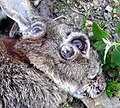 Rabbit with Myxomatosis 1 (RLH)
 -
 Myxomatosis in a pet rabbit
 -
 20190828 Myxomatosis MSW strain
 -
 Map of myxomatosis introductions with dates
 -
 Rabbits Myxomatosis Trial Wardang Island 1938
 -
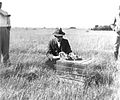 CSIRO Science Image 2232 Releasing the Myxoma Virus for Rabbits
 -
 Evolutionary History of MYXV
.jpg)

.jpg)


