Intelligence quotient: Difference between revisions
CSV import Tags: mobile edit mobile web edit |
CSV import |
||
| Line 27: | Line 27: | ||
{{stub}} | {{stub}} | ||
{{dictionary-stub1}} | {{dictionary-stub1}} | ||
<gallery> | |||
File:Raven_Matrix.svg|Raven's Progressive Matrices | |||
File:Alfred_Binet.jpg|Alfred Binet | |||
File:Raymond_Cattell.jpg|Raymond Cattell | |||
File:IQ_distribution.svg|IQ Distribution | |||
File:Stephen_Hawking.StarChild.jpg|Stephen Hawking | |||
</gallery> | |||
Latest revision as of 04:56, 18 February 2025
Intelligence quotient (often abbreviated as IQ) is a measure of a person's intellectual capabilities in comparison to the general population. It is a score derived from several standardized tests designed to assess human intelligence.
History[edit]
The term "intelligence quotient" was coined by the psychologist William Stern for the German term Intelligenzquotient. Stern proposed this method of comparing mental abilities in the year 1912. Later, Lewis Terman adapted this method for use with a series of tests which became known as the Stanford-Binet Intelligence Scales.
Calculation[edit]
The IQ score is calculated by dividing the individual's mental age (as measured by an intelligence test) by their chronological age and then multiplying by 100. For example, if a child of 10 years old has a mental age of 12, the child's IQ would be 120 (12/10 x 100).
Interpretation[edit]
IQ scores have been associated with factors such as morbidity and mortality, parental social status, and to a substantial degree, biological parental IQ. While the heritability of IQ has been investigated for nearly a century, there is still debate about the significance of heritability estimates and the mechanisms of inheritance.
Criticism[edit]
Critics argue that intelligence cannot be accurately measured by a single, standardized test. They suggest that these tests are biased towards the abilities valued in the Western societies.
See also[edit]
- Intelligence
- Stanford-Binet Intelligence Scales
- Wechsler Adult Intelligence Scale
- Cognitive Assessment
References[edit]
<references />
 | |
|---|---|
 |
 |
| This medical article is a stub. You can help Wikipedia by adding missing information. |
-
 Raven's Progressive Matrices
 -
 Alfred Binet
 -
 Raymond Cattell
 -
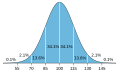 IQ Distribution
 -
 Stephen Hawking


