Outback: Difference between revisions
CSV import Tags: mobile edit mobile web edit |
CSV import |
||
| Line 22: | Line 22: | ||
{{Australia-stub}} | {{Australia-stub}} | ||
{{Geography-stub}} | {{Geography-stub}} | ||
<gallery> | |||
File:Yalgoo_Shire.jpg|Yalgoo Shire | |||
File:West_MacDonnell_National_Park.JPG|West MacDonnell National Park | |||
File:Fitzgerald_River_National_Park_DSC04436.JPG|Fitzgerald River National Park | |||
File:ISS007_Gosses_Bluff.jpg|Gosses Bluff from ISS | |||
File:RFDS_emergency_landing_strip_sign.jpg|RFDS Emergency Landing Strip Sign | |||
File:Gibb_River_Rd-1.jpg|Gibb River Road | |||
</gallery> | |||
Latest revision as of 11:00, 18 February 2025
Outback is the vast, remote, and arid area of Australia. The term "outback" is generally used to refer to locations that are comparatively more remote than those areas named "the bush".
Geography[edit]
The Outback is more remote than the bush, which includes any location outside the main urban areas. While often envisaged as being arid, the Outback regions extend from the northern to southern Australian coastlines and encompass a number of climatic zones, including tropical and monsoonal climates in northern areas, arid areas in the "red centre" and semi-arid and temperate climates in southerly regions.
Flora and Fauna[edit]
The Outback is home to a diverse set of animal species, such as the kangaroo, dingo, emu, and budgerigar. The dromedary camel, also known as an Arabian camel, exists as a feral population in the Outback, brought to Australia to help explore the country in the early days of European settlement.
Human Activity[edit]
While the Outback is thought of as a remote location, humans have been living in the region for approximately 50,000 years. The Indigenous Australians have been living in the Outback for tens of thousands of years, with their culture and spiritual beliefs closely tied to the land.
See Also[edit]

-
 Yalgoo Shire
 -
 West MacDonnell National Park
 -
 Fitzgerald River National Park
 -
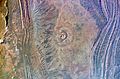 Gosses Bluff from ISS
 -
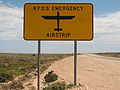 RFDS Emergency Landing Strip Sign
 -
 Gibb River Road


