Pons: Difference between revisions
CSV import |
CSV import |
||
| Line 32: | Line 32: | ||
{{stub}} | {{stub}} | ||
== Pons == | |||
<gallery> | |||
File:Brain_bulbar_region.svg|Diagram of the brain bulbar region | |||
File:Gray679.png|Gray's Anatomy illustration of the pons | |||
File:Lower_pons_horizontal_KB.svg|Horizontal section of the lower pons | |||
File:Pons.gif|Animated image of the pons | |||
File:Gray701.png|Gray's Anatomy illustration of the brainstem | |||
File:Gray719.png|Gray's Anatomy illustration of the pons and medulla oblongata | |||
File:Gray720.png|Gray's Anatomy illustration of the pons and cerebellum | |||
File:Brain_stem_sagittal_section.svg|Sagittal section of the brain stem | |||
File:Slide2cuc.JPG|Photograph of a brain section showing the pons | |||
</gallery> | |||
Latest revision as of 11:27, 18 February 2025
Pons
The Pons is a part of the brainstem that links the medulla oblongata and the thalamus. The pons contains nuclei that relay signals from the forebrain to the cerebellum, along with nuclei that deal primarily with sleep, respiration, swallowing, bladder control, hearing, equilibrium, taste, eye movement, facial expressions, facial sensation, and posture.
Structure[edit]
The pons is in the brainstem, and it sits above the medulla oblongata and below the midbrain. It is anterior to the cerebellum. The pons contains pathways or tracts that relay signals from the brain down to the cerebellum and medulla, and tracts that carry the sensory signals up into the thalamus.
Function[edit]
The main function of the pons is to serve as a bridge between various parts of the nervous system, including the cerebellum and cerebrum. In addition, the pons helps to regulate breathing and control the functions of the autonomic nervous system. It also relays sensory information between the cerebrum and cerebellum.
Clinical significance[edit]
Damage to the pons can lead to a number of neurological problems. For example, lesions in the pons can lead to Locked-in syndrome, a condition in which individuals can only move their eyes and are conscious but cannot move or communicate verbally due to complete paralysis of nearly all voluntary muscles in the body except for the eyes.
See also[edit]
References[edit]
<references />
External links[edit]
 | |
|---|---|
 |
 |
Pons[edit]
-
Diagram of the brain bulbar region
-
Gray's Anatomy illustration of the pons
-
Horizontal section of the lower pons
-
Animated image of the pons
-
Gray's Anatomy illustration of the brainstem
-
Gray's Anatomy illustration of the pons and medulla oblongata
-
Gray's Anatomy illustration of the pons and cerebellum
-
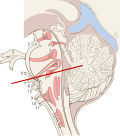 Sagittal section of the brain stem
 -
Photograph of a brain section showing the pons


