Turkish Taffy: Difference between revisions
CSV import |
CSV import |
||
| (One intermediate revision by the same user not shown) | |||
| Line 1: | Line 1: | ||
== Turkish Taffy == | == Turkish Taffy == | ||
Turkish Taffy | [[File:Bars_and_Twists_1.jpg|thumb|Various bars and twists of Turkish Taffy]] | ||
[[File:Bonomo-Turkish-Taffy-Selection.jpg|thumb|A selection of Bonomo Turkish Taffy flavors]] | |||
[[File:Early_Box_of_Bonomo_Turkish_Taffy.jpg|thumb|An early box of Bonomo Turkish Taffy]] | |||
'''Turkish Taffy''' is a type of [[taffy]] candy that was originally produced by the [[Bonomo]] company in the [[United States]]. Despite its name, Turkish Taffy is not a traditional [[Turkish cuisine|Turkish]] confectionery but rather an American creation. | |||
== History == | == History == | ||
Turkish Taffy was invented in the 1910s by [[Herman Herer]], a [[confectioner]] from [[New York City]]. The recipe was later sold to [[Victor Bonomo]], who began producing it under the Bonomo brand in the 1940s. The candy became popular in the 1950s and 1960s, especially after being featured on the [[Howdy Doody]] television show. | |||
The candy was originally available in four flavors: vanilla, chocolate, strawberry, and banana. It was known for its unique texture, which was both chewy and brittle, allowing it to be "cracked" into pieces by hitting it against a hard surface. | |||
== Production == | == Production == | ||
Turkish Taffy is made by [[aerating]] a mixture of [[corn syrup]], [[sugar]], and [[egg whites]], which is then cooked and cooled. The resulting candy is firm and can be broken into pieces. Unlike other taffies, Turkish Taffy is not pulled, which gives it its distinctive texture. | |||
== Revival == | |||
In the 1980s, production of Turkish Taffy ceased when the Bonomo brand was sold to [[Tootsie Roll Industries]], which discontinued the product. However, in 2010, Turkish Taffy was revived by the Bonomo family in partnership with [[Warrell Corporation]]. The candy is now produced using the original recipe and is available in its classic flavors. | |||
== Cultural Impact == | |||
Turkish Taffy holds a nostalgic place in American candy history, often remembered by those who grew up in the mid-20th century. It is frequently mentioned in [[pop culture]] and has a dedicated fan base that appreciates its unique qualities. | |||
== Related pages == | |||
* [[Taffy (candy)]] | * [[Taffy (candy)]] | ||
* [[Bonomo]] | |||
* [[Confectionery]] | |||
== References == | == References == | ||
{{reflist}} | |||
[[Category:American confectionery]] | |||
[[Category:Brand name confectionery]] | |||
<gallery> | |||
File:Bars_and_Twists_1.jpg|Turkish Taffy Bars and Twists | |||
File:Bonomo-Turkish-Taffy-Selection.jpg|Bonomo Turkish Taffy Selection | |||
File:Early_Box_of_Bonomo_Turkish_Taffy.jpg|Early Box of Bonomo Turkish Taffy | |||
</gallery> | |||
Latest revision as of 03:48, 18 February 2025
Turkish Taffy[edit]


Turkish Taffy is a type of taffy candy that was originally produced by the Bonomo company in the United States. Despite its name, Turkish Taffy is not a traditional Turkish confectionery but rather an American creation.
History[edit]
Turkish Taffy was invented in the 1910s by Herman Herer, a confectioner from New York City. The recipe was later sold to Victor Bonomo, who began producing it under the Bonomo brand in the 1940s. The candy became popular in the 1950s and 1960s, especially after being featured on the Howdy Doody television show.
The candy was originally available in four flavors: vanilla, chocolate, strawberry, and banana. It was known for its unique texture, which was both chewy and brittle, allowing it to be "cracked" into pieces by hitting it against a hard surface.
Production[edit]
Turkish Taffy is made by aerating a mixture of corn syrup, sugar, and egg whites, which is then cooked and cooled. The resulting candy is firm and can be broken into pieces. Unlike other taffies, Turkish Taffy is not pulled, which gives it its distinctive texture.
Revival[edit]
In the 1980s, production of Turkish Taffy ceased when the Bonomo brand was sold to Tootsie Roll Industries, which discontinued the product. However, in 2010, Turkish Taffy was revived by the Bonomo family in partnership with Warrell Corporation. The candy is now produced using the original recipe and is available in its classic flavors.
Cultural Impact[edit]
Turkish Taffy holds a nostalgic place in American candy history, often remembered by those who grew up in the mid-20th century. It is frequently mentioned in pop culture and has a dedicated fan base that appreciates its unique qualities.
Related pages[edit]
References[edit]
-
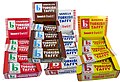 Turkish Taffy Bars and Twists
 -
 Bonomo Turkish Taffy Selection
 -
 Early Box of Bonomo Turkish Taffy
