Ependymoma: Difference between revisions
CSV import Tags: mobile edit mobile web edit |
CSV import |
||
| (One intermediate revision by the same user not shown) | |||
| Line 1: | Line 1: | ||
{{SI}} | |||
{{Infobox medical condition | |||
| name = Ependymoma | |||
| image = [[File:Ependymoma_low_intermed_mag.jpg|alt=Ependymoma under a microscope]] | |||
| caption = Micrograph of an ependymoma | |||
| field = [[Neuro-oncology]] | |||
| symptoms = [[Headache]], [[nausea]], [[vomiting]], [[ataxia]], [[seizures]] | |||
| onset = Can occur at any age, but more common in children | |||
| duration = Variable | |||
| types = [[Subependymoma]], [[Myxopapillary ependymoma]], [[Anaplastic ependymoma]] | |||
| causes = Unknown | |||
| risks = [[Neurofibromatosis type II]] | |||
| diagnosis = [[MRI]], [[CT scan]], [[biopsy]] | |||
| differential = [[Astrocytoma]], [[medulloblastoma]], [[choroid plexus papilloma]] | |||
| treatment = [[Surgery]], [[radiation therapy]], [[chemotherapy]] | |||
| prognosis = Variable, depends on type and location | |||
| frequency = Rare, accounts for 2-3% of all brain tumors | |||
}} | |||
'''Ependymoma''' is a type of [[tumor]] that can form in the [[brain]] or [[spinal cord]]. Ependymoma begins in the ependymal cells in the brain and spinal cord that line the passageways where the fluid (cerebrospinal fluid) that nourishes your brain flows. | '''Ependymoma''' is a type of [[tumor]] that can form in the [[brain]] or [[spinal cord]]. Ependymoma begins in the ependymal cells in the brain and spinal cord that line the passageways where the fluid (cerebrospinal fluid) that nourishes your brain flows. | ||
== Symptoms == | == Symptoms == | ||
The symptoms of ependymoma can vary greatly depending on the location of the tumor, the age of the person, and the size of the tumor. Some common symptoms include: | The symptoms of ependymoma can vary greatly depending on the location of the tumor, the age of the person, and the size of the tumor. Some common symptoms include: | ||
* [[Headache]] | * [[Headache]] | ||
* [[Nausea]] and [[vomiting]] | * [[Nausea]] and [[vomiting]] | ||
| Line 10: | Line 26: | ||
* Difficulty with balance and coordination | * Difficulty with balance and coordination | ||
* [[Hydrocephalus]] (buildup of fluid in the brain) | * [[Hydrocephalus]] (buildup of fluid in the brain) | ||
== Causes == | == Causes == | ||
The exact cause of ependymoma is not known. It is thought to occur when a cell develops errors (mutations) in its DNA. The mutations allow cells to grow and divide at an accelerated rate and to continue living when healthy cells would die. The accumulating abnormal cells form a mass (tumor). Ependymoma can occur at any age, but most often occurs in young children. | The exact cause of ependymoma is not known. It is thought to occur when a cell develops errors (mutations) in its DNA. The mutations allow cells to grow and divide at an accelerated rate and to continue living when healthy cells would die. The accumulating abnormal cells form a mass (tumor). Ependymoma can occur at any age, but most often occurs in young children. | ||
== Diagnosis == | == Diagnosis == | ||
Diagnosis of ependymoma involves a thorough examination by a doctor, including a neurological examination. Tests may include: | Diagnosis of ependymoma involves a thorough examination by a doctor, including a neurological examination. Tests may include: | ||
* [[MRI]] (Magnetic Resonance Imaging) | * [[MRI]] (Magnetic Resonance Imaging) | ||
* [[CT scan]] (Computed Tomography scan) | * [[CT scan]] (Computed Tomography scan) | ||
* [[Biopsy]] | * [[Biopsy]] | ||
== Treatment == | == Treatment == | ||
Treatment for ependymoma often involves surgery to remove as much of the tumor as possible. Other treatments may include: | Treatment for ependymoma often involves surgery to remove as much of the tumor as possible. Other treatments may include: | ||
* [[Radiation therapy]] | * [[Radiation therapy]] | ||
* [[Chemotherapy]] | * [[Chemotherapy]] | ||
* Targeted drug therapy | * Targeted drug therapy | ||
== Prognosis == | == Prognosis == | ||
The prognosis for ependymoma varies greatly depending on the location and size of the tumor, the person's age, and the extent of the tumor at the time of diagnosis. | The prognosis for ependymoma varies greatly depending on the location and size of the tumor, the person's age, and the extent of the tumor at the time of diagnosis. | ||
==Gallery== | |||
<gallery> | |||
File:Myxopapillary_ependymoma_-_high_mag.jpg|Myxopapillary ependymoma under high magnification | |||
File:Ependymom_ax_T2.jpg|Ependymoma axial T2 MRI | |||
File:Ependymom_sag_FLAIR.jpg|Ependymoma sagittal FLAIR MRI | |||
File:Ependymom_cor_T1KM.jpg|Ependymoma coronal T1 with contrast MRI | |||
</gallery> | |||
== See also == | == See also == | ||
* [[Brain tumor]] | * [[Brain tumor]] | ||
* [[Spinal cord tumor]] | * [[Spinal cord tumor]] | ||
* [[Cancer]] | * [[Cancer]] | ||
[[Category:Medical conditions]] | [[Category:Medical conditions]] | ||
[[Category:Neurological disorders]] | [[Category:Neurological disorders]] | ||
[[Category:Cancer]] | [[Category:Cancer]] | ||
{{stub}} | {{stub}} | ||
Latest revision as of 15:57, 6 April 2025

Editor-In-Chief: Prab R Tumpati, MD
Obesity, Sleep & Internal medicine
Founder, WikiMD Wellnesspedia &
W8MD's medical weight loss NYC, sleep center NYC
Philadelphia medical weight loss and Philadelphia sleep clinics
| Ependymoma | |
|---|---|

| |
| Synonyms | N/A |
| Pronounce | N/A |
| Specialty | N/A |
| Symptoms | Headache, nausea, vomiting, ataxia, seizures |
| Complications | N/A |
| Onset | Can occur at any age, but more common in children |
| Duration | Variable |
| Types | Subependymoma, Myxopapillary ependymoma, Anaplastic ependymoma |
| Causes | Unknown |
| Risks | Neurofibromatosis type II |
| Diagnosis | MRI, CT scan, biopsy |
| Differential diagnosis | Astrocytoma, medulloblastoma, choroid plexus papilloma |
| Prevention | N/A |
| Treatment | Surgery, radiation therapy, chemotherapy |
| Medication | N/A |
| Prognosis | Variable, depends on type and location |
| Frequency | Rare, accounts for 2-3% of all brain tumors |
| Deaths | N/A |
Ependymoma is a type of tumor that can form in the brain or spinal cord. Ependymoma begins in the ependymal cells in the brain and spinal cord that line the passageways where the fluid (cerebrospinal fluid) that nourishes your brain flows.
Symptoms[edit]
The symptoms of ependymoma can vary greatly depending on the location of the tumor, the age of the person, and the size of the tumor. Some common symptoms include:
- Headache
- Nausea and vomiting
- Seizures
- Changes in vision or hearing
- Difficulty with balance and coordination
- Hydrocephalus (buildup of fluid in the brain)
Causes[edit]
The exact cause of ependymoma is not known. It is thought to occur when a cell develops errors (mutations) in its DNA. The mutations allow cells to grow and divide at an accelerated rate and to continue living when healthy cells would die. The accumulating abnormal cells form a mass (tumor). Ependymoma can occur at any age, but most often occurs in young children.
Diagnosis[edit]
Diagnosis of ependymoma involves a thorough examination by a doctor, including a neurological examination. Tests may include:
Treatment[edit]
Treatment for ependymoma often involves surgery to remove as much of the tumor as possible. Other treatments may include:
- Radiation therapy
- Chemotherapy
- Targeted drug therapy
Prognosis[edit]
The prognosis for ependymoma varies greatly depending on the location and size of the tumor, the person's age, and the extent of the tumor at the time of diagnosis.
Gallery[edit]
-
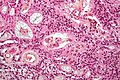 Myxopapillary ependymoma under high magnification
 -
 Ependymoma axial T2 MRI
 -
 Ependymoma sagittal FLAIR MRI
 -
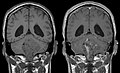 Ependymoma coronal T1 with contrast MRI


