Demographic transition: Difference between revisions
CSV import |
CSV import Tags: mobile edit mobile web edit |
||
| Line 33: | Line 33: | ||
[[Category:Medical Sociology]] | [[Category:Medical Sociology]] | ||
{{stub}} | {{stub}} | ||
<gallery> | |||
File:Demographic-TransitionOWID.png|Demographic transition | |||
File:Population_curve.svg|Demographic transition | |||
File:Angola_population_pyramid_2005.svg|Demographic transition | |||
File:Uzbekistan_population_pyramid.svg|Demographic transition | |||
File:Israel_2023_Population_Pyramid.svg|Demographic transition | |||
File:Familyplanningmalaysia.jpg|Demographic transition | |||
File:Argentina_2022_population_pyramid.svg|Demographic transition | |||
File:Portugal_population_pyramid.svg|Demographic transition | |||
File:Belarus_2023_population_pyramid.svg|Demographic transition | |||
File:World_population_(UN).svg|Demographic transition | |||
File:Dtm_pyramids.png|Demographic transition | |||
File:Demographic-Transition-5-countries.png|Demographic transition | |||
</gallery> | |||
Latest revision as of 12:07, 18 February 2025
Demographic transition refers to the transition from high birth and death rates to lower birth and death rates as a country or region develops from a pre-industrial to an industrialized economic system. The theory is based on an interpretation of demographic history developed in 1929 by the American demographer Warren Thompson (1887–1973).
Overview[edit]
The demographic transition model seeks to explain the transformation of countries from having high birth and death rates to low birth and death rates. In developed countries, this transition began in the eighteenth century and continues today. Less developed countries began the transition later and are still in the midst of earlier stages of the model.
Stages of Demographic Transition[edit]
The demographic transition model is divided into four stages:
Stage One[edit]
In Stage One, pre-industrial society, death rates and birth rates are high and roughly in balance. All human populations are believed to have had this balance until the late 18th century, when this balance ended in Western Europe.
Stage Two[edit]
In Stage Two, that of a developing country, the death rates drop quickly due to improvements in food supply and sanitation, which increase life spans and reduce disease. These changes usually come about due to improvements in farming techniques, access to technology, basic healthcare, and education.
Stage Three[edit]
In Stage Three, birth rates fall due to access to contraception, increases in wages, urbanization, a reduction in subsistence agriculture, an increase in the status and education of women, a reduction in the value of children's work, an increase in parental investment in the education of children and other social changes. Population growth begins to level off.
Stage Four[edit]
During Stage Four there are both low birth rates and low death rates. Birth rates may drop to well below replacement level as has happened in countries like Germany, Italy, and Japan, leading to a shrinking population, a threat to many industries that rely on population growth. As the large group born during stage two ages, it creates an economic burden on the shrinking working population. Death rates may remain consistently low or increase slightly due to increases in lifestyle diseases due to low exercise levels and high obesity and an aging population in developed countries.
See Also[edit]
References[edit]
<references />
 | This medical article is a stub. You can help WikiMD by expanding the page. |
-
 Demographic transition
 -
 Demographic transition
 -
 Demographic transition
 -
 Demographic transition
 -
 Demographic transition
 -
 Demographic transition
 -
 Demographic transition
 -
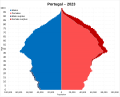 Demographic transition
 -
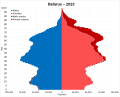 Demographic transition
 -
 Demographic transition
 -
 Demographic transition
 -
 Demographic transition


.svg)


