Fugazza: Difference between revisions
CSV import Tags: mobile edit mobile web edit |
CSV import |
||
| Line 21: | Line 21: | ||
[[Category:Argentinian cuisine]] | [[Category:Argentinian cuisine]] | ||
{{stub}} | {{stub}} | ||
<gallery> | |||
File:Banchero03.jpg|Banchero | |||
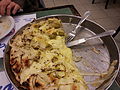
File:Fugazzeta_en_pizzeria_Guerrin,_Buenos_Aires.JPG|Fugazzeta en pizzeria Guerrin, Buenos Aires | |||
</gallery> | |||
Latest revision as of 21:33, 20 February 2025
Fugazza is a type of pizza that originated in Argentina. It is a variation of the traditional Italian pizza, but with a unique twist that sets it apart from its Italian counterpart. The name "Fugazza" is derived from the Italian word "focaccia", which is a type of flat oven-baked Italian bread.
Etymology[edit]
The term "Fugazza" is believed to have originated from the Italian word "focaccia". In Italian, "focaccia" refers to a type of flat oven-baked bread, which is similar to the base used in Fugazza. The term was likely adapted by Argentinians to refer to their unique variation of pizza.
Description[edit]
Fugazza is characterized by its thick, bread-like base, which is similar to the base used in focaccia. Unlike traditional Italian pizza, Fugazza does not typically include tomato sauce. Instead, it is topped with a generous amount of onions, often accompanied by other toppings such as cheese, olives, and herbs. The onions are usually caramelized, giving the pizza a sweet and savory flavor profile.
Variations[edit]
There are several variations of Fugazza, including Fugazza con queso and Fugazzeta. Fugazza con queso is similar to the traditional Fugazza, but includes cheese as a topping. Fugazzeta is a stuffed version of Fugazza, where the pizza is filled with cheese and topped with onions.
See also[edit]
References[edit]
<references />
 |
 |
-
 Banchero
 -
 Fugazzeta en pizzeria Guerrin, Buenos Aires


