Glenoid tubercles: Difference between revisions
CSV import Tags: mobile edit mobile web edit |
CSV import |
||
| Line 23: | Line 23: | ||
[[Category:Shoulder]] | [[Category:Shoulder]] | ||
{{stub}} | {{stub}} | ||
== Glenoid tubercles == | |||
<gallery> | |||
File:Gray205_left_scapula_lateral_view.png|Lateral view of left scapula | |||
File:Supraglenoid_tubercle_of_left_scapula_-_animation.gif|Supraglenoid tubercle of left scapula - animation | |||
File:Supraglenoid_tubercle_of_left_scapula01.png|Supraglenoid tubercle of left scapula | |||
File:Supraglenoid_tubercle_of_scapula_-_animation02.gif|Supraglenoid tubercle of scapula - animation | |||
File:Infraglenoid_tubercle_of_left_scapula_-_animation.gif|Infraglenoid tubercle of left scapula - animation | |||
File:Infraglenoid_tubercle_of_left_scapula01.png|Infraglenoid tubercle of left scapula | |||
File:Infraglenoid_tubercle_of_scapula_-_animation01.gif|Infraglenoid tubercle of scapula - animation | |||
</gallery> | |||
Latest revision as of 11:35, 18 February 2025
Glenoid Tubercles are anatomical features found in the shoulder joint. They are part of the scapula, or shoulder blade, and play a crucial role in the function of the shoulder.
Etymology[edit]
The term "glenoid" is derived from the Greek word "glenoeides", which means socket-like. "Tubercle" is derived from the Latin word "tuberculum", which means a small swelling or lump.
Anatomy[edit]
The glenoid tubercles are two small bony projections located on the edge of the glenoid cavity, which is the socket of the shoulder joint. These tubercles, the inferior glenoid tubercle and the superior glenoid tubercle, serve as attachment points for the glenohumeral ligaments, which are part of the capsule of shoulder joint that helps stabilize the joint.
The inferior glenoid tubercle is located at the lower part of the glenoid cavity, while the superior glenoid tubercle is located at the upper part. The space between these two tubercles is called the glenoid notch.
Function[edit]
The glenoid tubercles, along with the glenoid cavity, form a socket that accommodates the head of the humerus, or upper arm bone. This allows for a wide range of motion in the shoulder joint. The glenoid tubercles also provide attachment points for the glenohumeral ligaments, contributing to the stability of the shoulder joint.
Clinical Significance[edit]
Injuries or abnormalities of the glenoid tubercles can lead to shoulder instability and pain. Conditions such as glenoid labrum tear and glenohumeral joint instability can occur if the glenoid tubercles are damaged or worn down. Treatment for these conditions may include physical therapy, medication, or in severe cases, surgery.
See Also[edit]
 | |
|---|---|
 |
 |
Glenoid tubercles[edit]
-
 Lateral view of left scapula
 -
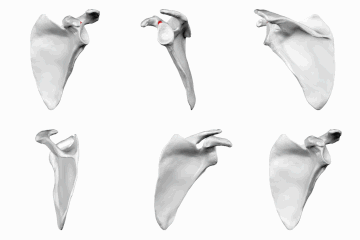 Supraglenoid tubercle of left scapula - animation
 -
 Supraglenoid tubercle of left scapula
 -
 Supraglenoid tubercle of scapula - animation
 -
 Infraglenoid tubercle of left scapula - animation
 -
 Infraglenoid tubercle of left scapula
 -
 Infraglenoid tubercle of scapula - animation


