Syzygium samarangense: Difference between revisions
CSV import |
CSV import |
||
| (2 intermediate revisions by the same user not shown) | |||
| Line 1: | Line 1: | ||
== Syzygium samarangense == | {{short description|Species of flowering plant}} | ||
{{Taxobox | |||
| name = Syzygium samarangense | |||
| image = Syzygium_fruit.jpg | |||
| image_caption = Syzygium samarangense fruit | |||
| genus = Syzygium | |||
| species = S. samarangense | |||
| authority = (Blume) Merr. & L.M.Perry | |||
}} | |||
Syzygium samarangense, | '''Syzygium samarangense''', commonly known as the wax apple, love apple, or Java apple, is a species of flowering plant in the [[Myrtaceae]] family. It is native to the [[Malay Peninsula]], [[Andaman and Nicobar Islands]], and the [[Greater Sunda Islands]], but has been widely cultivated in other tropical regions. | ||
==Description== | |||
[[File:2014-04-26_Syzygium_samarangense_01_anagoria.JPG|thumb|left|Flowers of Syzygium samarangense]] | |||
Syzygium samarangense is a tropical tree growing to 12 meters tall, with evergreen leaves that are opposite, simple, and elliptic to oblong. The leaves are 10–25 cm long and 5–10 cm wide. The flowers are white, 2.5 cm in diameter, with four petals and numerous stamens. | |||
The fruit is a bell-shaped berry, 4–6 cm long, with a waxy skin that can be pink, red, or white. The flesh is crisp and juicy, with a mild, sweet flavor. The fruit is often eaten fresh or used in salads. | |||
=== | ==Cultivation== | ||
[[File:Bell_Fruit_-_%E0%B4%9A%E0%B4%BE%E0%B4%AE%E0%B5%8D%E0%B4%AA_04.JPG|thumb|right|Bell fruit in cultivation]] | |||
Syzygium samarangense is cultivated in tropical and subtropical regions around the world. It prefers well-drained soil and a sunny position. The tree is drought-tolerant but benefits from regular watering during dry periods. | |||
Propagation is usually by seed, but grafting and air layering are also used to produce improved cultivars. The tree is relatively pest-free, but can be affected by fruit flies and fungal diseases. | |||
== | ==Uses== | ||
[[File:Taiwan_fruits.jpg|thumb|left|Syzygium samarangense fruits in a market]] | |||
The fruit of Syzygium samarangense is consumed fresh, often with a sprinkle of salt or sugar. It is also used in fruit salads and desserts. In some cultures, the fruit is used in traditional medicine to treat various ailments. | |||
The wood of the tree is hard and durable, making it suitable for construction and furniture making. | |||
== | ==Cultural significance== | ||
In many tropical regions, Syzygium samarangense is an important fruit tree, both economically and culturally. It is often grown in home gardens and is a common sight in local markets. | |||
==Gallery== | |||
<gallery> | |||
File:Hoa_của_loài_roi.jpg|Flowers of Syzygium samarangense | |||
File:2014-04-26_Syzygium_samarangense_04_anagoria.JPG|Close-up of the fruit | |||
File:Jambakai01.jpg|Syzygium samarangense fruit | |||
File:Jambakai02.jpg|Another view of the fruit | |||
</gallery> | |||
==Related pages== | |||
* [[Syzygium]] | * [[Syzygium]] | ||
* [[Myrtaceae]] | |||
* [[Tropical fruit]] | * [[Tropical fruit]] | ||
[[Category: | [[Category:Syzygium|samarangense]] | ||
[[Category:Tropical fruit]] | [[Category:Tropical fruit]] | ||
[[Category: | [[Category:Flora of the Andaman Islands]] | ||
[[Category:Flora of the Nicobar Islands]] | |||
[[Category:Flora of the Malay Peninsula]] | |||
Latest revision as of 14:11, 21 February 2025
Species of flowering plant
Syzygium samarangense, commonly known as the wax apple, love apple, or Java apple, is a species of flowering plant in the Myrtaceae family. It is native to the Malay Peninsula, Andaman and Nicobar Islands, and the Greater Sunda Islands, but has been widely cultivated in other tropical regions.
Description[edit]

Syzygium samarangense is a tropical tree growing to 12 meters tall, with evergreen leaves that are opposite, simple, and elliptic to oblong. The leaves are 10–25 cm long and 5–10 cm wide. The flowers are white, 2.5 cm in diameter, with four petals and numerous stamens.
The fruit is a bell-shaped berry, 4–6 cm long, with a waxy skin that can be pink, red, or white. The flesh is crisp and juicy, with a mild, sweet flavor. The fruit is often eaten fresh or used in salads.
Cultivation[edit]

Syzygium samarangense is cultivated in tropical and subtropical regions around the world. It prefers well-drained soil and a sunny position. The tree is drought-tolerant but benefits from regular watering during dry periods.
Propagation is usually by seed, but grafting and air layering are also used to produce improved cultivars. The tree is relatively pest-free, but can be affected by fruit flies and fungal diseases.
Uses[edit]

The fruit of Syzygium samarangense is consumed fresh, often with a sprinkle of salt or sugar. It is also used in fruit salads and desserts. In some cultures, the fruit is used in traditional medicine to treat various ailments.
The wood of the tree is hard and durable, making it suitable for construction and furniture making.
Cultural significance[edit]
In many tropical regions, Syzygium samarangense is an important fruit tree, both economically and culturally. It is often grown in home gardens and is a common sight in local markets.
Gallery[edit]
-
 Flowers of Syzygium samarangense
 -
 Close-up of the fruit
 -
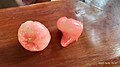 Syzygium samarangense fruit
 -
 Another view of the fruit


