Portunus trituberculatus: Difference between revisions
CSV import Tags: mobile edit mobile web edit |
CSV import |
||
| Line 49: | Line 49: | ||
[[Category:Commercial crustaceans]] | [[Category:Commercial crustaceans]] | ||
[[Category:Portunidae]] | [[Category:Portunidae]] | ||
== Portunus trituberculatus == | |||
<gallery> | |||
File:Portunus_trituberculatus.jpg|Portunus trituberculatus | |||
File:Gazami_crab,_capture_production,_thousand_tonnes,_1950-2022.svg|Gazami crab capture production, thousand tonnes, 1950-2022 | |||
</gallery> | |||
Latest revision as of 01:26, 18 February 2025
Portunus trituberculatus[edit]
Portunus trituberculatus, commonly known as the Gazami crab, Japanese blue crab, or Horse crab, is a species of crab that is native to the coastal waters of East Asia. It is the most widely fished species of crab in the world, with over 300,000 tonnes being caught annually, primarily in China and Korea.
Taxonomy[edit]
Portunus trituberculatus belongs to the Portunidae family of crabs, which includes over 100 genera. The species was first described by British zoologist John Edward Gray in 1831. The genus name 'Portunus' is derived from the Roman god of keys, doors, and livestock, while 'trituberculatus' refers to the three tubercles or bumps on the carapace of the crab.
Description[edit]
The Gazami crab is a large species, with males reaching a carapace width of up to 22 cm. The carapace is a mottled greenish-blue color, with three distinct tubercles on the front. The legs are long and spindly, with sharp points at the ends. The claws are large and powerful, used for both defense and feeding.
Distribution and Habitat[edit]
Portunus trituberculatus is found in the coastal waters of East Asia, from Russia and Japan in the north, to Taiwan and the Philippines in the south. It inhabits sandy or muddy bottoms, usually at depths of 10-50 meters.
Diet[edit]
The diet of the Gazami crab consists mainly of small invertebrates, such as mollusks and worms, but it is also known to eat algae and detritus.
Reproduction[edit]
The breeding season for Portunus trituberculatus is from May to September. Females carry the fertilized eggs under their abdomen until they hatch into larvae. The larvae go through several stages of development before metamorphosing into juvenile crabs.
Economic Importance[edit]
The Gazami crab is of significant economic importance in East Asia, particularly in China and Korea, where it is extensively fished. It is also farmed in aquaculture facilities. The meat is considered a delicacy and is often used in traditional dishes.
Conservation Status[edit]
Despite its wide distribution and high fishing pressure, Portunus trituberculatus is not currently considered threatened. However, overfishing and habitat degradation are potential threats to the species.
See Also[edit]
References[edit]
<references />
External Links[edit]
Portunus trituberculatus[edit]
-
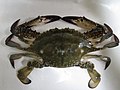 Portunus trituberculatus
 -
 Gazami crab capture production, thousand tonnes, 1950-2022


