V-1 flying bomb: Difference between revisions
CSV import |
CSV import |
||
| (One intermediate revision by the same user not shown) | |||
| Line 1: | Line 1: | ||
== V-1 Flying Bomb == | == V-1 Flying Bomb == | ||
The V-1 flying bomb | The '''V-1 flying bomb''' (German: ''Vergeltungswaffe 1'') was an early cruise missile and the first of the so-called [[V-weapons]] series deployed for terror bombing of [[London]] during [[World War II]]. It was developed by [[Nazi Germany]] and used primarily by the [[Luftwaffe]]. | ||
=== Development | === Development === | ||
The development of the V-1 | The V-1 was designed by the [[Fieseler]] company and was powered by a simple [[pulsejet]] engine. The development of the V-1 began in 1939, and it was first tested in 1942. The project was led by [[Robert Lusser]] and [[Fritz Gosslau]]. | ||
=== Design === | |||
The V-1 was a small, pilotless aircraft with a wingspan of 5.3 meters and a length of 8.3 meters. It was powered by an Argus As 014 pulsejet engine, which gave it a top speed of 640 km/h (400 mph). The bomb carried a 850 kg (1,870 lb) warhead and had a range of approximately 250 km (160 miles). | |||
=== Launch and Operation === | |||
The V-1 was launched from | The V-1 was launched from a simple ramp using a steam catapult. It was guided by a simple autopilot system that used a gyroscope and a magnetic compass. The V-1 was launched from sites in [[France]] and the [[Netherlands]] towards targets in [[England]]. | ||
=== Impact === | |||
The first V-1 attack on London occurred on June 13, 1944. The attacks continued until October 1944, when the launch sites were overrun by [[Allied forces]]. In total, over 9,500 V-1s were launched against England, with around 2,419 reaching London. | |||
=== Countermeasures === | |||
The V-1 | The [[British]] developed several countermeasures to combat the V-1 threat. These included anti-aircraft guns, barrage balloons, and fighter aircraft such as the [[Supermarine Spitfire]] and [[Hawker Tempest]]. The [[Royal Air Force]] also developed a tactic known as "tipping," where pilots would use their aircraft to tip the wings of the V-1, causing it to crash. | ||
=== | === Legacy === | ||
The V-1 was the first operational cruise missile and paved the way for future developments in missile technology. It was succeeded by the more advanced [[V-2 rocket]]. | |||
== Related Pages == | |||
* [[V-2 rocket]] | |||
* [[Luftwaffe]] | |||
* [[World War II]] | * [[World War II]] | ||
* [[ | * [[Nazi Germany]] | ||
== | == Gallery == | ||
< | <gallery> | ||
File:V-1_cutaway.jpg|Cutaway view of a V-1 | |||
File:V1_Launcher_IWM_Duxford.JPG|V-1 launcher at IWM Duxford | |||
File:V1Musee.jpg|V-1 on display in a museum | |||
File:V1_flying_bomb_on_ramp.jpg|V-1 on launch ramp | |||
File:V1_piston.jpg|V-1 engine piston | |||
File:V-1_(Fieseler_Fi_103)_in_flight.jpg|V-1 in flight | |||
File:Mile_end_grove_road_2.jpg|V-1 bomb damage in London | |||
File:Fieseler_Fi103_debajo_de_un_Heinkel_111.jpg|V-1 under a Heinkel 111 | |||
File:Fi103R_at_La_Coupole.jpg|Fi 103R at La Coupole | |||
File:Arado_Ar_234_Blitz_mit_V1_pic1.JPG|Arado Ar 234 with V-1 | |||
File:The_British_Army_in_the_United_Kingdom_1939-45_H39728.jpg|British Army with V-1 | |||
File:The_Royal_Observer_Corps_in_Britain,_1943_TR1444.jpg|Royal Observer Corps | |||
File:Spitfire_Tipping_V-1_Flying_Bomb.jpg|Spitfire tipping a V-1 | |||
File:Flying_Bomb-_V1_Bomb_Damage_in_London,_England,_UK,_1944_D21237.jpg|V-1 bomb damage in London | |||
File:Bundesarchiv_Bild_146-1981-004-19,_Max_Wachtel.jpg|Max Wachtel with V-1 | |||
File:DoodleBug1.JPG|V-1 "Doodlebug" | |||
File:USS_Cusk;0834807.jpg|USS Cusk with V-1 | |||
File:13_Greencastle_V-1.JPG|V-1 at Greencastle | |||
File:V1_at_the_Stampe_&_Vertongen_Museum,_Antwerp_International_Airport,_Belgium.jpg|V-1 at Antwerp | |||
File:V1_launch_ramp_IWM_duxford.JPG|V-1 launch ramp at IWM Duxford | |||
File:Imperial_War_Museum,_London_(geograph_4108596)_(cropped).jpg|V-1 at Imperial War Museum | |||
File:Air_Zoo_December_2019_024_(V-1_flying_bomb).jpg|V-1 at Air Zoo | |||
</gallery> | |||
[[Category:World War II weapons]] | [[Category:World War II weapons of Germany]] | ||
[[Category: | [[Category:Cruise missiles]] | ||
<gallery> | |||
File:Bundesarchiv_Bild_146-1975-117-26,_Marschflugkörper_V1_vor_Start.jpg|V-1 flying bomb | |||
File:V-1_cutaway.jpg|V-1 flying bomb | |||
File:V1_Launcher_IWM_Duxford.JPG|V-1 flying bomb | |||
File:V1Musee.jpg|V-1 flying bomb | |||
File:Launcher_of_V-1_rocket_in_Historisch-technisches_Informationszentrum_Peenemünde_(1).JPG|V-1 flying bomb | |||
File:V1_flying_bomb_on_ramp.jpg|V-1 flying bomb | |||
File:V1_piston.jpg|V-1 flying bomb | |||
File:V-1_(Fieseler_Fi_103)_in_flight.jpg|V-1 flying bomb | |||
File:Mile_end_grove_road_2.jpg|V-1 flying bomb | |||
File:Bundesarchiv_Bild_146-1973-029A-24A,_Marschflugkörper_V1_vor_Start.jpg|V-1 flying bomb | |||
File:Fieseler_Fi103_debajo_de_un_Heinkel_111.jpg|V-1 flying bomb | |||
File:Fi103R_at_La_Coupole.jpg|V-1 flying bomb | |||
</gallery> | |||
Latest revision as of 11:52, 18 February 2025
V-1 Flying Bomb[edit]
The V-1 flying bomb (German: Vergeltungswaffe 1) was an early cruise missile and the first of the so-called V-weapons series deployed for terror bombing of London during World War II. It was developed by Nazi Germany and used primarily by the Luftwaffe.
Development[edit]
The V-1 was designed by the Fieseler company and was powered by a simple pulsejet engine. The development of the V-1 began in 1939, and it was first tested in 1942. The project was led by Robert Lusser and Fritz Gosslau.
Design[edit]
The V-1 was a small, pilotless aircraft with a wingspan of 5.3 meters and a length of 8.3 meters. It was powered by an Argus As 014 pulsejet engine, which gave it a top speed of 640 km/h (400 mph). The bomb carried a 850 kg (1,870 lb) warhead and had a range of approximately 250 km (160 miles).
Launch and Operation[edit]
The V-1 was launched from a simple ramp using a steam catapult. It was guided by a simple autopilot system that used a gyroscope and a magnetic compass. The V-1 was launched from sites in France and the Netherlands towards targets in England.
Impact[edit]
The first V-1 attack on London occurred on June 13, 1944. The attacks continued until October 1944, when the launch sites were overrun by Allied forces. In total, over 9,500 V-1s were launched against England, with around 2,419 reaching London.
Countermeasures[edit]
The British developed several countermeasures to combat the V-1 threat. These included anti-aircraft guns, barrage balloons, and fighter aircraft such as the Supermarine Spitfire and Hawker Tempest. The Royal Air Force also developed a tactic known as "tipping," where pilots would use their aircraft to tip the wings of the V-1, causing it to crash.
Legacy[edit]
The V-1 was the first operational cruise missile and paved the way for future developments in missile technology. It was succeeded by the more advanced V-2 rocket.
Related Pages[edit]
Gallery[edit]
-
 Cutaway view of a V-1
 -
 V-1 launcher at IWM Duxford
 -
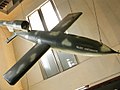 V-1 on display in a museum
 -
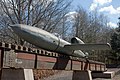 V-1 on launch ramp
 -
 V-1 engine piston
 -
V-1 in flight
-
 V-1 bomb damage in London
 -
 V-1 under a Heinkel 111
 -
 Fi 103R at La Coupole
 -
 Arado Ar 234 with V-1
 -
 British Army with V-1
 -
 Royal Observer Corps
 -
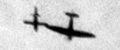 Spitfire tipping a V-1
 -
 V-1 bomb damage in London
 -
 Max Wachtel with V-1
 -
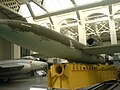 V-1 "Doodlebug"
 -
 USS Cusk with V-1
 -
 V-1 at Greencastle
 -
 V-1 at Antwerp
 -
 V-1 launch ramp at IWM Duxford
 -
 V-1 at Imperial War Museum
 -
 V-1 at Air Zoo


.jpg)
-
 V-1 flying bomb
 -
V-1 flying bomb
-
V-1 flying bomb
-
V-1 flying bomb
-
 V-1 flying bomb
 -
V-1 flying bomb
-
V-1 flying bomb
-
V-1 flying bomb
-
V-1 flying bomb
-
 V-1 flying bomb
 -
V-1 flying bomb
-
V-1 flying bomb

.JPG)


_in_flight.jpg)