Government: Difference between revisions
CSV import |
|||
| Line 62: | Line 62: | ||
* [[Glossary of government terms]] | * [[Glossary of government terms]] | ||
[[Category:Government]] | [[Category:Government]] | ||
<gallery> | |||
File:The_Harmsworth_atlas_and_Gazetter_1908_Government_systems_world_map.jpg|Government systems world map from 1908 | |||
File:Democracy_claims.svg|Claims of democracy | |||
File:Electoral_democracies.svg|Map of electoral democracies | |||
File:Separation_of_powers.png|Diagram of separation of powers | |||
File:EIU_Democracy_Index_2017.svg|EIU Democracy Index 2017 | |||
File:Blank_Map_World_Secondary_Political_Divisions.svg|Blank map of world secondary political divisions | |||
File:Map_of_unitary_and_federal_states.svg|Map of unitary and federal states | |||
</gallery> | |||
Latest revision as of 11:43, 18 February 2025
the act of governing; exercising authority: (government) the system or form by which a community or other political unit is governed; the organization that is the governing authority of a political unit; the study of government of states and other political units.
Introduction[edit]
The term government denotes the organization or system through which a body of people exercises authority over a state, region, or community. Governments are responsible for creating and enforcing the laws and policies that guide the conduct of a nation and its citizens.
Definitions[edit]
A government is the system or group of people governing an organized community, generally a state. It can also be described as the administration of a particular state at a given time.
Types of Governments[edit]
Democracy[edit]
In a democracy, the power lies with the people, who exercise that power directly or through elected representatives.
Republic[edit]
A republic is a form of government where the country is considered a "public matter", and the head of state is an elected or nominated president, not a monarch.
Monarchy[edit]
Monarchies are governments led by a king or queen who inherits their position from their family lineage.
Authoritarian and Totalitarian Regimes[edit]
These governments concentrate power in the hands of one ruler or a small group of leaders who often exercise control over all aspects of life.
Functions of Government[edit]
Governments are responsible for providing a stable framework that facilitates economic prosperity, maintaining order, protecting citizens from external threats, and providing public services.
The Role of Government in Society[edit]
Governments play a key role in the development and stability of societies. They have the responsibility to protect the nation's economy, security, and the rights and freedoms of its citizens.
Government Structure[edit]
Executive[edit]
The executive branch is responsible for the day-to-day administration of the state.
Legislative[edit]
The legislative branch is tasked with making laws and altering existing ones.
Judiciary[edit]
The judiciary interprets the laws and administers justice.
Governance in Different Countries[edit]
Each country has its own system of governance that may combine different elements of government types and may function in unique ways in response to its culture, history, and societal values.
Challenges in Governance[edit]
Governments face various challenges, including corruption, maintaining law and order, protecting rights, and managing resources and the economy.
Common terms[edit]
- Bicameral - A type of legislature that has two separate chambers or houses, typically an upper and a lower house.
- Bill - A proposal for a new law, or a proposal to amend or repeal an existing law, that is presented for debate and approval in a legislature.
- Cabinet - A body of high-ranking officials, typically consisting of the top leaders of the executive branch in a government. They are usually called ministers and each is in charge of a specific area of government function.
- Democracy - A system of government where the citizens exercise power by voting.
- Executive branch - The branch of government responsible for implementing and enforcing laws, and is typically headed by the president or prime minister.
- Judiciary - The judicial branch of government, responsible for interpreting laws and administering justice.
- Legislature - The legislative branch of government, which is responsible for enacting laws.
- Majority rule - A decision rule that selects alternatives which have more than half the votes.
- Opposition (politics) - A political party or group that is not in government but acts as a critical watchdog of the party or coalition that does govern.
- Parliament - A legislative body of government. In many countries, it is composed of two housesthe lower house (often called the House of Representatives) and the upper house (often called the Senate).
- Prime Minister - The head of the government in a parliamentary system.
- Republic - A form of government in which the country is considered a "public matter" and the head of state is an elected or nominated president, not a monarch.
- Veto - The power of a president or governor to reject a bill proposed by a legislature by not signing it into law.
- Voting system - A method by which voters make a choice between options, often in an election or on a policy referendum.
Also see[edit]
-
 Government systems world map from 1908
 -
 Claims of democracy
 -
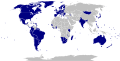 Map of electoral democracies
 -
 Diagram of separation of powers
 -
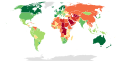 EIU Democracy Index 2017
 -
 Blank map of world secondary political divisions
 -
 Map of unitary and federal states


