Superior rectus muscle: Difference between revisions
Redirected page to Superior rectus Tags: New redirect visualeditor-wikitext |
CSV import |
||
| (One intermediate revision by the same user not shown) | |||
| Line 1: | Line 1: | ||
{{Short description|One of the extraocular muscles responsible for eye movement}} | |||
The '''superior rectus muscle''' is one of the six [[extraocular muscles]] that control the movements of the [[eye]]. It is primarily responsible for the elevation of the eye, allowing it to look upward. This muscle plays a crucial role in the complex coordination required for proper [[binocular vision]]. | |||
==Anatomy== | |||
The superior rectus muscle is located in the orbit, the bony cavity that houses the eye. It originates from the [[annulus of Zinn]], a tendinous ring located at the apex of the orbit. From its origin, the muscle extends forward and slightly upward, inserting into the superior aspect of the [[sclera]], the white outer coating of the eyeball, just posterior to the [[cornea]]. | |||
The muscle is innervated by the [[oculomotor nerve]] (cranial nerve III), which provides the necessary motor signals for its contraction. The blood supply to the superior rectus muscle is primarily from the [[ophthalmic artery]], a branch of the [[internal carotid artery]]. | |||
==Function== | |||
The primary function of the superior rectus muscle is to elevate the eye, moving the pupil upward. In addition to elevation, the muscle also contributes to [[intorsion]] (rotation of the top of the eye toward the nose) and [[adduction]] (movement of the eye toward the midline). These actions are essential for coordinated eye movements and maintaining proper alignment of the visual axes. | |||
The superior rectus muscle works in conjunction with other extraocular muscles, such as the [[inferior rectus muscle]], [[medial rectus muscle]], and [[lateral rectus muscle]], to achieve smooth and precise eye movements. The [[superior oblique muscle]] and [[inferior oblique muscle]] also assist in complex eye movements, particularly those involving torsion. | |||
==Clinical significance== | |||
Dysfunction of the superior rectus muscle can lead to various ocular motility disorders. For instance, [[strabismus]], a condition characterized by misalignment of the eyes, can occur if the muscle is weak or paralyzed. This may result in [[diplopia]] (double vision) and difficulty with depth perception. | |||
Injuries or lesions affecting the oculomotor nerve can impair the function of the superior rectus muscle, leading to a condition known as [[oculomotor nerve palsy]]. This condition can cause the affected eye to deviate downward and outward, as the unopposed action of the lateral rectus and superior oblique muscles take over. | |||
==Related pages== | |||
* [[Extraocular muscles]] | |||
* [[Oculomotor nerve]] | |||
* [[Strabismus]] | |||
* [[Diplopia]] | |||
* [[Annulus of Zinn]] | |||
{{Extraocular muscles}} | |||
[[Category:Muscles of the head and neck]] | |||
[[Category:Human eye anatomy]] | |||
==Superior rectus muscle== | |||
<gallery> | |||
File:Gray891.png|Gray891 | |||
File:Trochlear_and_frontal_nerves.jpg|Trochlear and frontal nerves | |||
File:Slide2uu.JPG|Slide2uu | |||
File:Slide1abaa.JPG|Slide1abaa | |||
File:Slide2abaa.JPG|Slide2abaa | |||
File:Slide4abab.JPG|Slide4abab | |||
File:Slide6abab.JPG|Slide6abab | |||
File:Slide8ababa.JPG|Slide8ababa | |||
</gallery> | |||
Latest revision as of 20:54, 25 February 2025
One of the extraocular muscles responsible for eye movement
The superior rectus muscle is one of the six extraocular muscles that control the movements of the eye. It is primarily responsible for the elevation of the eye, allowing it to look upward. This muscle plays a crucial role in the complex coordination required for proper binocular vision.
Anatomy[edit]
The superior rectus muscle is located in the orbit, the bony cavity that houses the eye. It originates from the annulus of Zinn, a tendinous ring located at the apex of the orbit. From its origin, the muscle extends forward and slightly upward, inserting into the superior aspect of the sclera, the white outer coating of the eyeball, just posterior to the cornea.
The muscle is innervated by the oculomotor nerve (cranial nerve III), which provides the necessary motor signals for its contraction. The blood supply to the superior rectus muscle is primarily from the ophthalmic artery, a branch of the internal carotid artery.
Function[edit]
The primary function of the superior rectus muscle is to elevate the eye, moving the pupil upward. In addition to elevation, the muscle also contributes to intorsion (rotation of the top of the eye toward the nose) and adduction (movement of the eye toward the midline). These actions are essential for coordinated eye movements and maintaining proper alignment of the visual axes.
The superior rectus muscle works in conjunction with other extraocular muscles, such as the inferior rectus muscle, medial rectus muscle, and lateral rectus muscle, to achieve smooth and precise eye movements. The superior oblique muscle and inferior oblique muscle also assist in complex eye movements, particularly those involving torsion.
Clinical significance[edit]
Dysfunction of the superior rectus muscle can lead to various ocular motility disorders. For instance, strabismus, a condition characterized by misalignment of the eyes, can occur if the muscle is weak or paralyzed. This may result in diplopia (double vision) and difficulty with depth perception.
Injuries or lesions affecting the oculomotor nerve can impair the function of the superior rectus muscle, leading to a condition known as oculomotor nerve palsy. This condition can cause the affected eye to deviate downward and outward, as the unopposed action of the lateral rectus and superior oblique muscles take over.
Related pages[edit]
| Extraocular muscles | ||||||
|---|---|---|---|---|---|---|
This extraocular muscles related article is a stub.
|
Superior rectus muscle[edit]
-
 Gray891
 -
 Trochlear and frontal nerves
 -
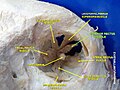 Slide2uu
 -
Slide1abaa
-
Slide2abaa
-
 Slide4abab
 -
Slide6abab
-
Slide8ababa


