Hearing: Difference between revisions
No edit summary Tag: visualeditor-wikitext |
CSV import |
||
| (One intermediate revision by the same user not shown) | |||
| Line 1: | Line 1: | ||
{{Infobox Anatomy | |||
| Name = Hearing | |||
| Latin = Auditus | |||
| Image = | |||
| Caption = | |||
| System = [[Auditory system]] | |||
| Function = Sense of sound | |||
}} | |||
'''Hearing''' is the ability to perceive [[sound]] by detecting vibrations through an organ such as the [[ear]]. It is one of the major senses of humans and many animals. Hearing is crucial for [[communication]], [[learning]], and [[navigation]]. | |||
== | ==Mechanism== | ||
Hearing involves the complex process of sound wave propagation, which is captured by the ear and converted into electrical signals that are interpreted by the [[brain]]. The primary components of the auditory system include the outer ear, middle ear, inner ear, and the auditory pathways in the brain. | |||
===Outer Ear=== | |||
The outer ear consists of the pinna and the ear canal. Its primary function is to capture sound waves and funnel them into the ear canal. | |||
===Middle Ear=== | |||
The middle ear contains three bones known as the [[ossicles]]: the malleus, incus, and stapes. These bones help to amplify and transmit the sound vibrations from the ear drum to the inner ear. | |||
===Inner Ear=== | |||
[[ | The inner ear contains the [[cochlea]], a spiral-shaped, fluid-filled tube. It is lined with thousands of tiny hair cells that convert the vibrations into electrical signals. | ||
===Auditory Pathways=== | |||
The electrical signals are then transmitted via the auditory nerve to the brain, particularly to the auditory cortex, where they are interpreted as sound. | |||
[[ | ==Function== | ||
[[Category: | Hearing enables individuals to detect sounds of varying frequencies and intensities. It allows for the recognition of speech, music, and environmental sounds, playing a crucial role in communication and alertness to surroundings. | ||
[[Category: | |||
==Hearing Loss== | |||
[[Hearing loss]] can result from damage to any part of the auditory system and can vary in severity. It is categorized into conductive, sensorineural, and mixed hearing loss. Factors contributing to hearing loss include genetics, aging, exposure to loud noise, infections, and certain medications. | |||
==Prevention and Treatment== | |||
Preventative measures include avoiding exposure to loud noises, using protective ear equipment, and regular hearing check-ups. Treatment options vary depending on the cause and severity of hearing loss and may include hearing aids, cochlear implants, and surgical interventions. | |||
==Cultural and Social Aspects== | |||
Hearing is integral to many cultural practices, including music and language. Societies have developed sign languages and other communication methods to support individuals with hearing loss. | |||
==See Also== | |||
* [[Audiology]] | |||
* [[Deaf culture]] | |||
* [[Ear anatomy]] | |||
* [[Sound]] | |||
* [[Speech perception]] | |||
[[Category:Sensory system]] | |||
[[Category:Hearing]] | |||
{{medicine-stub}} | |||
<gallery> | |||
File:Journey of Sound to the Brain.ogg|Journey of Sound to the Brain | |||
File:Tidens naturlære fig40.png|Tidens naturlære fig40 | |||
File:Gray919.png|Gray's Anatomy Diagram | |||
File:Right osseous labyrinth svg hariadhi.svg|Right Osseous Labyrinth | |||
File:Lateral lemniscus.PNG|Lateral Lemniscus | |||
File:Domestic cat felis catus.jpg|Domestic Cat Felis Catus | |||
</gallery> | |||
Latest revision as of 01:20, 20 February 2025
| General Information | |
|---|---|
| Latin | Auditus |
| Greek | |
| TA98 | |
| TA2 | |
| FMA | |
| Details | |
| System | Auditory system |
| Artery | |
| Vein | |
| Nerve | |
| Lymphatic drainage | |
| Precursor | |
| Function | Sense of sound |
| Identifiers | |
| Clinical significance | |
| Notes | |
Hearing is the ability to perceive sound by detecting vibrations through an organ such as the ear. It is one of the major senses of humans and many animals. Hearing is crucial for communication, learning, and navigation.
Mechanism[edit]
Hearing involves the complex process of sound wave propagation, which is captured by the ear and converted into electrical signals that are interpreted by the brain. The primary components of the auditory system include the outer ear, middle ear, inner ear, and the auditory pathways in the brain.
Outer Ear[edit]
The outer ear consists of the pinna and the ear canal. Its primary function is to capture sound waves and funnel them into the ear canal.
Middle Ear[edit]
The middle ear contains three bones known as the ossicles: the malleus, incus, and stapes. These bones help to amplify and transmit the sound vibrations from the ear drum to the inner ear.
Inner Ear[edit]
The inner ear contains the cochlea, a spiral-shaped, fluid-filled tube. It is lined with thousands of tiny hair cells that convert the vibrations into electrical signals.
Auditory Pathways[edit]
The electrical signals are then transmitted via the auditory nerve to the brain, particularly to the auditory cortex, where they are interpreted as sound.
Function[edit]
Hearing enables individuals to detect sounds of varying frequencies and intensities. It allows for the recognition of speech, music, and environmental sounds, playing a crucial role in communication and alertness to surroundings.
Hearing Loss[edit]
Hearing loss can result from damage to any part of the auditory system and can vary in severity. It is categorized into conductive, sensorineural, and mixed hearing loss. Factors contributing to hearing loss include genetics, aging, exposure to loud noise, infections, and certain medications.
Prevention and Treatment[edit]
Preventative measures include avoiding exposure to loud noises, using protective ear equipment, and regular hearing check-ups. Treatment options vary depending on the cause and severity of hearing loss and may include hearing aids, cochlear implants, and surgical interventions.
Cultural and Social Aspects[edit]
Hearing is integral to many cultural practices, including music and language. Societies have developed sign languages and other communication methods to support individuals with hearing loss.
See Also[edit]

-
 Journey of Sound to the Brain
 -
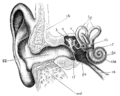 Tidens naturlære fig40
 -
 Gray's Anatomy Diagram
 -
 Right Osseous Labyrinth
 -
 Lateral Lemniscus
 -
 Domestic Cat Felis Catus


