Cutaneous larva migrans: Difference between revisions
CSV import |
CSV import Tags: mobile edit mobile web edit |
||
| Line 1: | Line 1: | ||
{{SI}} | |||
{{Infobox medical condition | |||
| name = Cutaneous larva migrans | |||
| image = [[File:Larva_Migrans_Cutanea.jpg|left|thumb|Cutaneous larva migrans on the foot]] | |||
| caption = Cutaneous larva migrans on the foot | |||
| synonyms = Creeping eruption, sandworm disease, plumber's itch | |||
| field = [[Infectious disease]] | |||
| symptoms = Itchy, red, winding rash | |||
| complications = [[Secondary infection]] | |||
| onset = 1-5 days after exposure | |||
| duration = Weeks to months | |||
| causes = [[Ancylostoma braziliense]], [[Ancylostoma caninum]] | |||
| risks = Walking barefoot on contaminated soil | |||
| diagnosis = Clinical evaluation | |||
| differential = [[Tinea corporis]], [[Scabies]], [[Contact dermatitis]] | |||
| prevention = Wearing shoes, avoiding contaminated areas | |||
| treatment = [[Albendazole]], [[Ivermectin]] | |||
| frequency = Common in tropical and subtropical regions | |||
}} | |||
'''Cutaneous larva migrans''' is a skin disease in humans, caused by the larvae of various nematode parasites of the hookworm family (Ancylostomatidae). The most common species causing this disease in the Americas are ''[[Ancylostoma braziliense]]'' and ''[[Ancylostoma caninum]]'', both of which are found in the feces of dogs and cats. | '''Cutaneous larva migrans''' is a skin disease in humans, caused by the larvae of various nematode parasites of the hookworm family (Ancylostomatidae). The most common species causing this disease in the Americas are ''[[Ancylostoma braziliense]]'' and ''[[Ancylostoma caninum]]'', both of which are found in the feces of dogs and cats. | ||
== Causes == | == Causes == | ||
Cutaneous larva migrans is caused by infection with hookworm larvae in contaminated soil. The larvae are able to penetrate the skin and migrate under the skin's surface, causing intense itching and a characteristic serpiginous track marking. | Cutaneous larva migrans is caused by infection with hookworm larvae in contaminated soil. The larvae are able to penetrate the skin and migrate under the skin's surface, causing intense itching and a characteristic serpiginous track marking. | ||
== Symptoms == | == Symptoms == | ||
The main symptom of cutaneous larva migrans is intense itching, which is caused by the migration of the larvae under the skin. The larvae leave a characteristic serpiginous track, which is a visible red line that moves as the larvae migrate. Other symptoms may include a rash, blisters, and swelling. | The main symptom of cutaneous larva migrans is intense itching, which is caused by the migration of the larvae under the skin. The larvae leave a characteristic serpiginous track, which is a visible red line that moves as the larvae migrate. Other symptoms may include a rash, blisters, and swelling. | ||
== Diagnosis == | == Diagnosis == | ||
The diagnosis of cutaneous larva migrans is primarily based on the characteristic clinical presentation. The history of exposure to a potentially contaminated environment, such as a beach or a sandbox, is also important. Laboratory tests are not usually necessary, but a skin biopsy may be performed in some cases. | The diagnosis of cutaneous larva migrans is primarily based on the characteristic clinical presentation. The history of exposure to a potentially contaminated environment, such as a beach or a sandbox, is also important. Laboratory tests are not usually necessary, but a skin biopsy may be performed in some cases. | ||
== Treatment == | == Treatment == | ||
The treatment of cutaneous larva migrans includes oral medications such as [[albendazole]] and [[ivermectin]]. Topical treatments, such as [[thiabendazole]], can also be used. In some cases, the infection may resolve on its own without treatment. | The treatment of cutaneous larva migrans includes oral medications such as [[albendazole]] and [[ivermectin]]. Topical treatments, such as [[thiabendazole]], can also be used. In some cases, the infection may resolve on its own without treatment. | ||
== Prevention == | == Prevention == | ||
Prevention of cutaneous larva migrans involves avoiding contact with potentially contaminated soil, especially in areas where dogs and cats are present. Wearing protective footwear in these areas can also help prevent infection. | Prevention of cutaneous larva migrans involves avoiding contact with potentially contaminated soil, especially in areas where dogs and cats are present. Wearing protective footwear in these areas can also help prevent infection. | ||
== Gallery == | |||
<gallery> | |||
File:Cutaneous larva migrans 1.jpg|Cutaneous larva migrans | |||
File:Cutaneous-larva-migrans-foot.jpg|Cutaneous larva migrans | |||
</gallery> | |||
== See also == | == See also == | ||
* [[Hookworm infection]] | * [[Hookworm infection]] | ||
* [[Parasitic skin diseases]] | * [[Parasitic skin diseases]] | ||
* [[Dermatology]] | * [[Dermatology]] | ||
[[Category:Dermatology]] | [[Category:Dermatology]] | ||
[[Category:Parasitic diseases]] | [[Category:Parasitic diseases]] | ||
[[Category:Zoonoses]] | [[Category:Zoonoses]] | ||
{{stub}} | {{stub}} | ||
Latest revision as of 13:38, 5 April 2025

Editor-In-Chief: Prab R Tumpati, MD
Obesity, Sleep & Internal medicine
Founder, WikiMD Wellnesspedia &
W8MD medical weight loss NYC and sleep center NYC
| Cutaneous larva migrans | |
|---|---|
 | |
| Synonyms | Creeping eruption, sandworm disease, plumber's itch |
| Pronounce | N/A |
| Specialty | N/A |
| Symptoms | Itchy, red, winding rash |
| Complications | Secondary infection |
| Onset | 1-5 days after exposure |
| Duration | Weeks to months |
| Types | N/A |
| Causes | Ancylostoma braziliense, Ancylostoma caninum |
| Risks | Walking barefoot on contaminated soil |
| Diagnosis | Clinical evaluation |
| Differential diagnosis | Tinea corporis, Scabies, Contact dermatitis |
| Prevention | Wearing shoes, avoiding contaminated areas |
| Treatment | Albendazole, Ivermectin |
| Medication | N/A |
| Prognosis | N/A |
| Frequency | Common in tropical and subtropical regions |
| Deaths | N/A |
Cutaneous larva migrans is a skin disease in humans, caused by the larvae of various nematode parasites of the hookworm family (Ancylostomatidae). The most common species causing this disease in the Americas are Ancylostoma braziliense and Ancylostoma caninum, both of which are found in the feces of dogs and cats.
Causes[edit]
Cutaneous larva migrans is caused by infection with hookworm larvae in contaminated soil. The larvae are able to penetrate the skin and migrate under the skin's surface, causing intense itching and a characteristic serpiginous track marking.
Symptoms[edit]
The main symptom of cutaneous larva migrans is intense itching, which is caused by the migration of the larvae under the skin. The larvae leave a characteristic serpiginous track, which is a visible red line that moves as the larvae migrate. Other symptoms may include a rash, blisters, and swelling.
Diagnosis[edit]
The diagnosis of cutaneous larva migrans is primarily based on the characteristic clinical presentation. The history of exposure to a potentially contaminated environment, such as a beach or a sandbox, is also important. Laboratory tests are not usually necessary, but a skin biopsy may be performed in some cases.
Treatment[edit]
The treatment of cutaneous larva migrans includes oral medications such as albendazole and ivermectin. Topical treatments, such as thiabendazole, can also be used. In some cases, the infection may resolve on its own without treatment.
Prevention[edit]
Prevention of cutaneous larva migrans involves avoiding contact with potentially contaminated soil, especially in areas where dogs and cats are present. Wearing protective footwear in these areas can also help prevent infection.
Gallery[edit]
-
 Cutaneous larva migrans
 -
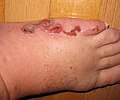 Cutaneous larva migrans


