Chemical burn: Difference between revisions
CSV import |
CSV import |
||
| Line 1: | Line 1: | ||
{{SI}} | |||
{{Infobox medical condition | |||
| name = Chemical burn | |||
| image = [[File:Mustard_gas_burns.jpg|250px]] | |||
| caption = Chemical burns caused by [[mustard gas]] | |||
| synonyms = Caustic burn | |||
| field = [[Toxicology]], [[Dermatology]] | |||
| symptoms = [[Redness]], [[blistering]], [[pain]], [[swelling]] | |||
| complications = [[Infection]], [[scarring]], [[chemical pneumonitis]] | |||
| onset = Immediate or delayed | |||
| duration = Varies depending on severity | |||
| causes = Exposure to [[acids]], [[bases]], [[oxidizers]], [[solvents]] | |||
| risks = [[Industrial accidents]], [[household cleaning]], [[chemical warfare]] | |||
| diagnosis = Based on [[history]] and [[physical examination]] | |||
| differential = [[Thermal burn]], [[radiation burn]], [[allergic contact dermatitis]] | |||
| prevention = Use of [[personal protective equipment]], [[safety protocols]] | |||
| treatment = [[Irrigation]], [[debridement]], [[pain management]], [[antibiotics]] | |||
| prognosis = Depends on extent and depth of burn | |||
| frequency = Common in [[industrial settings]] | |||
}} | |||
'''Chemical burn''' refers to the damage and irritation of body tissues caused by exposure to a [[chemical substance]]. This can occur through direct contact with the skin or eyes, inhalation, or ingestion of a chemical. The severity of a chemical burn can vary widely depending on the nature of the chemical, the duration of exposure, and the amount of chemical involved. | '''Chemical burn''' refers to the damage and irritation of body tissues caused by exposure to a [[chemical substance]]. This can occur through direct contact with the skin or eyes, inhalation, or ingestion of a chemical. The severity of a chemical burn can vary widely depending on the nature of the chemical, the duration of exposure, and the amount of chemical involved. | ||
==Causes== | ==Causes== | ||
Chemical burns are caused by acidic or alkaline substances that come into contact with the body. Common chemicals that can cause burns include [[sulfuric acid]], [[hydrochloric acid]], [[sodium hydroxide]] (lye), [[lime]] (calcium oxide), [[silver nitrate]], and [[phenol]]. Household cleaners, industrial chemicals, and even some personal care products can contain these substances. | Chemical burns are caused by acidic or alkaline substances that come into contact with the body. Common chemicals that can cause burns include [[sulfuric acid]], [[hydrochloric acid]], [[sodium hydroxide]] (lye), [[lime]] (calcium oxide), [[silver nitrate]], and [[phenol]]. Household cleaners, industrial chemicals, and even some personal care products can contain these substances. | ||
==Symptoms== | ==Symptoms== | ||
Symptoms of a chemical burn can include: | Symptoms of a chemical burn can include: | ||
| Line 11: | Line 29: | ||
* Coughing or difficulty breathing if fumes are inhaled | * Coughing or difficulty breathing if fumes are inhaled | ||
* Vision changes if the chemical contacts the eyes | * Vision changes if the chemical contacts the eyes | ||
==First Aid and Treatment== | ==First Aid and Treatment== | ||
Immediate first aid is crucial in managing chemical burns and can significantly affect the outcome. Steps include: | Immediate first aid is crucial in managing chemical burns and can significantly affect the outcome. Steps include: | ||
| Line 17: | Line 34: | ||
2. '''Rinsing the Burn''': Rinse the affected area with cool, running water for at least 20 minutes. Avoid using a strong water jet to prevent further injury. | 2. '''Rinsing the Burn''': Rinse the affected area with cool, running water for at least 20 minutes. Avoid using a strong water jet to prevent further injury. | ||
3. '''Seeking Medical Attention''': After initial first aid, seek professional medical treatment, especially for severe burns, burns affecting sensitive areas like the eyes, or if the chemical was ingested. | 3. '''Seeking Medical Attention''': After initial first aid, seek professional medical treatment, especially for severe burns, burns affecting sensitive areas like the eyes, or if the chemical was ingested. | ||
Treatment by healthcare professionals may involve pain management, wound care, and in some cases, treatments to counteract the chemical's effects. | Treatment by healthcare professionals may involve pain management, wound care, and in some cases, treatments to counteract the chemical's effects. | ||
==Prevention== | ==Prevention== | ||
Preventing chemical burns involves proper handling and storage of chemicals, including: | Preventing chemical burns involves proper handling and storage of chemicals, including: | ||
| Line 25: | Line 40: | ||
* Reading and following chemical labels and Material Safety Data Sheets (MSDS) | * Reading and following chemical labels and Material Safety Data Sheets (MSDS) | ||
* Storing chemicals safely and securely away from children and pets | * Storing chemicals safely and securely away from children and pets | ||
==Complications== | ==Complications== | ||
Complications from chemical burns can include infections, scarring, and in severe cases, disability or death. Inhalation of chemical fumes can also cause respiratory issues. | Complications from chemical burns can include infections, scarring, and in severe cases, disability or death. Inhalation of chemical fumes can also cause respiratory issues. | ||
==See Also== | ==See Also== | ||
* [[Burn]] | * [[Burn]] | ||
| Line 34: | Line 47: | ||
* [[Toxicology]] | * [[Toxicology]] | ||
* [[Occupational safety and health]] | * [[Occupational safety and health]] | ||
[[Category:Injuries]] | [[Category:Injuries]] | ||
[[Category:Toxicology]] | [[Category:Toxicology]] | ||
Latest revision as of 21:19, 4 April 2025

Editor-In-Chief: Prab R Tumpati, MD
Obesity, Sleep & Internal medicine
Founder, WikiMD Wellnesspedia &
W8MD medical weight loss NYC and sleep center NYC
| Chemical burn | |
|---|---|

| |
| Synonyms | Caustic burn |
| Pronounce | N/A |
| Specialty | N/A |
| Symptoms | Redness, blistering, pain, swelling |
| Complications | Infection, scarring, chemical pneumonitis |
| Onset | Immediate or delayed |
| Duration | Varies depending on severity |
| Types | N/A |
| Causes | Exposure to acids, bases, oxidizers, solvents |
| Risks | Industrial accidents, household cleaning, chemical warfare |
| Diagnosis | Based on history and physical examination |
| Differential diagnosis | Thermal burn, radiation burn, allergic contact dermatitis |
| Prevention | Use of personal protective equipment, safety protocols |
| Treatment | Irrigation, debridement, pain management, antibiotics |
| Medication | N/A |
| Prognosis | Depends on extent and depth of burn |
| Frequency | Common in industrial settings |
| Deaths | N/A |
Chemical burn refers to the damage and irritation of body tissues caused by exposure to a chemical substance. This can occur through direct contact with the skin or eyes, inhalation, or ingestion of a chemical. The severity of a chemical burn can vary widely depending on the nature of the chemical, the duration of exposure, and the amount of chemical involved.
Causes[edit]
Chemical burns are caused by acidic or alkaline substances that come into contact with the body. Common chemicals that can cause burns include sulfuric acid, hydrochloric acid, sodium hydroxide (lye), lime (calcium oxide), silver nitrate, and phenol. Household cleaners, industrial chemicals, and even some personal care products can contain these substances.
Symptoms[edit]
Symptoms of a chemical burn can include:
- Redness and irritation at the site of contact
- Pain or burning sensation
- Blistering or peeling skin
- Coughing or difficulty breathing if fumes are inhaled
- Vision changes if the chemical contacts the eyes
First Aid and Treatment[edit]
Immediate first aid is crucial in managing chemical burns and can significantly affect the outcome. Steps include: 1. Removing the Chemical: Quickly remove any clothing or jewelry contaminated by the chemical. If the chemical is dry, brush it off the skin before rinsing. 2. Rinsing the Burn: Rinse the affected area with cool, running water for at least 20 minutes. Avoid using a strong water jet to prevent further injury. 3. Seeking Medical Attention: After initial first aid, seek professional medical treatment, especially for severe burns, burns affecting sensitive areas like the eyes, or if the chemical was ingested. Treatment by healthcare professionals may involve pain management, wound care, and in some cases, treatments to counteract the chemical's effects.
Prevention[edit]
Preventing chemical burns involves proper handling and storage of chemicals, including:
- Using personal protective equipment (PPE) such as gloves, goggles, and aprons
- Reading and following chemical labels and Material Safety Data Sheets (MSDS)
- Storing chemicals safely and securely away from children and pets
Complications[edit]
Complications from chemical burns can include infections, scarring, and in severe cases, disability or death. Inhalation of chemical fumes can also cause respiratory issues.
See Also[edit]
- Chemical_burn
-
 Mustard gas burns
 -
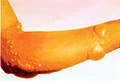 Blister on arm
 -
 Mustard gas chemical burns on combat soldier of the First World War in France, about 1918
 -
 Mustard gas burns
 -
 Blister from chemical exposure
 -
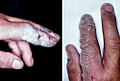 HF burned hands
 -
 My hand with minor chemical burns


