CX614: Difference between revisions
CSV import |
No edit summary |
||
| Line 27: | Line 27: | ||
{{medicine-stub}} | {{medicine-stub}} | ||
<gallery> | <gallery> | ||
File:CX614.png|Image of CX614 | File:CX614.png|Image of CX614 | ||
File:CX614_molecule_ball.png|Ball-and-stick model of CX614 molecule | File:CX614_molecule_ball.png|Ball-and-stick model of CX614 molecule | ||
</gallery> | </gallery> | ||
Latest revision as of 19:30, 16 March 2025
CX614 is an ampakine compound and a nootropic that is primarily used in scientific research. It has been studied for its potential therapeutic applications in the treatment of neurological and psychiatric disorders such as Alzheimer's disease, schizophrenia, and attention deficit hyperactivity disorder (ADHD).
Chemistry[edit]
CX614 is a derivative of benzoylpiperidine, and is structurally related to other ampakines such as CX516 and CX717. It acts as a positive allosteric modulator of the AMPA receptor, enhancing the activity of this receptor to increase neurotransmission and improve cognition.
Pharmacology[edit]
The primary mechanism of action of CX614 is the potentiation of AMPA receptors, which are a type of ionotropic glutamate receptor. By enhancing the activity of these receptors, CX614 increases the release of glutamate, the primary excitatory neurotransmitter in the brain. This results in increased neuronal activity and improved cognitive function.
Clinical Research[edit]
Research on CX614 has focused on its potential therapeutic applications. Preclinical studies have shown that it can enhance memory and learning in animal models, suggesting potential benefits for conditions characterized by cognitive impairment, such as Alzheimer's disease and schizophrenia. However, clinical trials in humans have not yet been conducted.
Safety and Tolerability[edit]
The safety and tolerability of CX614 are not fully known, as clinical trials in humans have not yet been conducted. However, preclinical studies in animals have not shown significant adverse effects at therapeutic doses.
See Also[edit]
- AMPA receptor
- Ampakine
- Nootropic
- Alzheimer's disease
- Schizophrenia
- Attention deficit hyperactivity disorder (ADHD)

-
 Image of CX614
 -
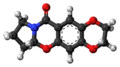 Ball-and-stick model of CX614 molecule


