Orthograde posture: Difference between revisions
CSV import |
CSV import |
||
| Line 29: | Line 29: | ||
{{Medicine-stub}} | {{Medicine-stub}} | ||
== Orthograde posture gallery == | |||
<gallery> | |||
File:Propithecus bipedal gallop.svg|Propithecus bipedal gallop | |||
File:Shoulder joint.svg|Shoulder joint | |||
</gallery> | |||
Latest revision as of 06:12, 3 March 2025
Orthograde posture refers to the upright orientation of the body or the head in relation to gravity. This posture is primarily observed in primates, including humans, where the body is held upright either in a sitting or standing position. Orthograde posture is a significant evolutionary adaptation that has allowed for the development of bipedal locomotion in humans, facilitating a wide range of activities including running, walking, and the manipulation of objects with the hands.
Evolutionary Significance[edit]
The evolution of orthograde posture is closely linked to the transition from arboreal (tree-dwelling) to terrestrial (ground-dwelling) life. In primates, this postural adaptation is thought to have initially evolved to facilitate feeding on small branches and twigs, where an upright posture could provide better reach and balance. Over time, this adaptation has played a crucial role in the development of bipedalism, particularly in the human lineage. The shift to an upright posture has significant implications for the anatomical structure of primates, including changes in the spine, pelvis, and lower limbs to support the weight of the body in an upright position.
Anatomical Adaptations[edit]
Orthograde posture necessitates several anatomical adaptations to maintain balance and mobility. In humans, these adaptations include:
- A spinal column with an S-shaped curve, which helps to distribute body weight and absorb shock during movement.
- A broad, short pelvis that supports the internal organs and provides attachment points for muscles that are crucial for bipedal locomotion.
- Legs that are longer relative to the arms, enhancing the efficiency of walking and running.
- The development of an arched foot, which acts as a spring to absorb impact and aid in propulsion.
Implications for Human Health[edit]
While orthograde posture and bipedalism offer numerous advantages, they also present specific challenges to human health. The upright posture places significant stress on the spine and lower back, leading to common conditions such as lower back pain. Additionally, the reliance on the lower limbs for mobility increases the risk of injury and degenerative conditions such as osteoarthritis.
Cultural and Social Aspects[edit]
The adoption of an orthograde posture has also had profound cultural and social implications. The ability to walk upright freed the hands for tool use and manipulation, which has been a driving force in human technological and cultural evolution. Furthermore, the development of an upright posture has influenced social interactions, with the face and eyes playing a more prominent role in communication and social bonding.
See Also[edit]

Orthograde posture gallery[edit]
-
 Propithecus bipedal gallop
 -
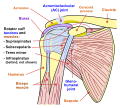 Shoulder joint


