Fiersviridae: Difference between revisions
CSV import |
CSV import |
||
| (One intermediate revision by the same user not shown) | |||
| Line 1: | Line 1: | ||
{{DISPLAYTITLE:Fiersviridae}} | {{DISPLAYTITLE:Fiersviridae}} | ||
'''Fiersviridae''' is a family of [[RNA viruses]] that infect [[bacteria]], specifically those in the [[Enterobacteriaceae]] family. These viruses are known as [[bacteriophages]], or simply phages, and they play a significant role in the regulation of bacterial populations in various environments. | '''Fiersviridae''' is a family of [[RNA viruses]] that infect [[bacteria]], specifically those in the [[Enterobacteriaceae]] family. These viruses are known as [[bacteriophages]], or simply phages, and they play a significant role in the regulation of bacterial populations in various environments. | ||
| Line 27: | Line 24: | ||
[[Category:RNA viruses]] | [[Category:RNA viruses]] | ||
[[Category:Bacteriophages]] | [[Category:Bacteriophages]] | ||
<gallery> | |||
File:Viruses-10-00386-g002.png|Viruses-10-00386-g002 | |||
File:1-s2.0-S0022283615006762-gr1-C.jpg|1-s2.0-S0022283615006762-gr1-C | |||
</gallery> | |||
Latest revision as of 05:42, 3 March 2025
Fiersviridae is a family of RNA viruses that infect bacteria, specifically those in the Enterobacteriaceae family. These viruses are known as bacteriophages, or simply phages, and they play a significant role in the regulation of bacterial populations in various environments.
Taxonomy[edit]
The family Fiersviridae is part of the order Levivirales. It includes several genera, with the most well-known being the genus Levivirus. Members of this family are characterized by their small, icosahedral capsids and single-stranded RNA genomes.
Structure[edit]
Fiersviridae viruses have a simple structure, consisting of a protein shell, or capsid, that encases their genetic material. The capsid is composed of multiple copies of a single protein, forming a symmetrical icosahedral shape. The genome is a single-stranded, positive-sense RNA molecule, which is directly translated by the host cell's ribosomes upon infection.
Life Cycle[edit]
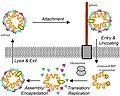
The life cycle of Fiersviridae viruses begins with the attachment of the phage to the surface of a susceptible bacterial cell. This is mediated by specific interactions between the phage's capsid proteins and receptors on the bacterial surface. Once attached, the phage injects its RNA genome into the host cell, where it hijacks the host's ribosomes to produce viral proteins.
The viral RNA is replicated by the host's RNA-dependent RNA polymerase, and new viral particles are assembled in the cytoplasm. Eventually, the host cell lyses, releasing the newly formed phages to infect other bacterial cells.
Significance[edit]
Fiersviridae viruses are important tools in molecular biology and genetic engineering. They have been used extensively in research to understand the mechanisms of RNA replication and protein synthesis. Additionally, they serve as models for studying virus-host interactions and the evolution of RNA viruses.
Related Pages[edit]
-
 Viruses-10-00386-g002
 -
 1-s2.0-S0022283615006762-gr1-C


