Radiation hardening: Difference between revisions
CSV import |
CSV import Tags: mobile edit mobile web edit |
||
| (One intermediate revision by the same user not shown) | |||
| Line 1: | Line 1: | ||
{{Short description|Techniques to make electronic components resistant to radiation damage}} | |||
{{Use dmy dates|date=October 2023}} | |||
{{Infobox technology}} | |||
'''Radiation hardening''' is the process of making electronic components and systems resistant to damage or malfunctions caused by [[ionizing radiation]] such as [[particle radiation]] and [[electromagnetic radiation]], particularly at high-energy levels. This is crucial for [[satellite]]s, [[spacecraft]], [[nuclear power plant]]s, and [[military]] applications where electronics are exposed to high levels of radiation. | |||
== | ==Overview== | ||
Radiation can cause various types of damage to electronic components, including [[single-event upset]]s (SEUs), [[total ionizing dose]] (TID) effects, and [[displacement damage]]. Radiation hardening involves designing and testing components to ensure they can withstand these effects. | |||
==Techniques== | |||
Several techniques are used in radiation hardening: | |||
''' | * '''Material selection''': Using materials that are inherently resistant to radiation, such as [[silicon on insulator]] (SOI) technology. | ||
* '''Design techniques''': Implementing [[redundancy]] and [[error correction]] codes to mitigate the effects of radiation-induced errors. | |||
* '''Shielding''': Using physical barriers to protect components from radiation exposure. | |||
* '''Process technology''': Developing specialized manufacturing processes that enhance radiation tolerance. | |||
== Applications == | ==Applications== | ||
Radiation | Radiation-hardened components are essential in: | ||
* [[Space exploration]]: Protecting [[satellite]]s and [[spacecraft]] from cosmic rays and solar radiation. | |||
* [[Military]]: Ensuring the reliability of [[nuclear weapon]]s and [[defense systems]] in radiation-rich environments. | |||
* [[Nuclear power]]: Safeguarding control systems in [[nuclear reactors]]. | |||
== | ==Challenges== | ||
The main challenges in radiation hardening include: | |||
* '''Cost''': Radiation-hardened components are typically more expensive to produce. | |||
* '''Performance''': There can be trade-offs between radiation hardness and performance metrics such as speed and power consumption. | |||
== | ==See also== | ||
* [[Radiation testing]] | |||
* [[Radiation protection]] | |||
* [[Space environment]] | |||
==References== | |||
{{Reflist}} | |||
== | ==External links== | ||
* [ | * [https://www.nasa.gov NASA Radiation Hardening] | ||
* [https://www.militaryaerospace.com Military Aerospace Radiation Hardening] | |||
* [ | |||
[[Category:Radiation effects on electronics]] | |||
[[Category:Radiation | |||
[[Category:Spacecraft components]] | [[Category:Spacecraft components]] | ||
[[Category:Military technology]] | [[Category:Military technology]] | ||
[[Category:Nuclear technology]] | |||
<gallery> | |||
File:1886VE10-HD.jpg|1886VE10-HD | |||
File:1886VE10-Si-HD.jpg|1886VE10-Si-HD | |||
</gallery> | |||
Latest revision as of 05:14, 3 March 2025
Techniques to make electronic components resistant to radiation damage
Radiation hardening
| Type | |
|---|---|
| Inventor | |
| Inception | |
| Manufacturer | |
| Available | |
| Discontinued | |
| Website | [ Official website] |
| Related articles |
{{This technology related article is a stub.}}
Radiation hardening is the process of making electronic components and systems resistant to damage or malfunctions caused by ionizing radiation such as particle radiation and electromagnetic radiation, particularly at high-energy levels. This is crucial for satellites, spacecraft, nuclear power plants, and military applications where electronics are exposed to high levels of radiation.
Overview[edit]
Radiation can cause various types of damage to electronic components, including single-event upsets (SEUs), total ionizing dose (TID) effects, and displacement damage. Radiation hardening involves designing and testing components to ensure they can withstand these effects.
Techniques[edit]
Several techniques are used in radiation hardening:
- Material selection: Using materials that are inherently resistant to radiation, such as silicon on insulator (SOI) technology.
- Design techniques: Implementing redundancy and error correction codes to mitigate the effects of radiation-induced errors.
- Shielding: Using physical barriers to protect components from radiation exposure.
- Process technology: Developing specialized manufacturing processes that enhance radiation tolerance.
Applications[edit]
Radiation-hardened components are essential in:
- Space exploration: Protecting satellites and spacecraft from cosmic rays and solar radiation.
- Military: Ensuring the reliability of nuclear weapons and defense systems in radiation-rich environments.
- Nuclear power: Safeguarding control systems in nuclear reactors.
Challenges[edit]
The main challenges in radiation hardening include:
- Cost: Radiation-hardened components are typically more expensive to produce.
- Performance: There can be trade-offs between radiation hardness and performance metrics such as speed and power consumption.
See also[edit]
References[edit]
<references group="" responsive="1"></references>
External links[edit]
-
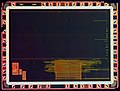 1886VE10-HD
 -
 1886VE10-Si-HD


