Rotational symmetry: Difference between revisions
CSV import |
CSV import |
||
| Line 24: | Line 24: | ||
{{Medicine-stub}} | {{Medicine-stub}} | ||
<gallery> | |||
File:The armoured triskelion on the flag of the Isle of Man.svg|The armoured triskelion on the flag of the Isle of Man | |||
File:Double pendulum flips graph.png|Double pendulum flips graph | |||
File:Finland road sign 166 (1995–2020).svg|Finland road sign 166 (1995–2020) | |||
File:Cyclic symmetry 4.png|Cyclic symmetry 4 | |||
File:United States Bicentennial star 1976 (geometry).svg|United States Bicentennial star 1976 (geometry) | |||
File:Cyclic symmetry 6.png|Cyclic symmetry 6 | |||
File:En-300px-Shogi.png|Shogi | |||
File:Snoldelev-three-interlaced-horns.svg|Snoldelev three interlaced horns | |||
File:Op-art-4-sided-spiral-tunnel-7.svg|Op art 4 sided spiral tunnel 7 | |||
File:15crossings-decorative-knot.svg|15 crossings decorative knot | |||
</gallery> | |||
Latest revision as of 05:08, 3 March 2025
Rotational Symmetry in the context of biology and medicine, particularly in the structure of molecules and anatomical structures, plays a crucial role in understanding the functionality and the design of various biological entities. This article aims to explore the concept of rotational symmetry, its significance in biological systems, and examples that illustrate its application in the field of medicine and biology.
Definition[edit]
Rotational symmetry, also known as radial symmetry, occurs when an object is rotated around a central point or axis and the object appears the same at certain rotational angles. The number of times the object matches its original position in one complete 360-degree rotation determines its order of symmetry.
Importance in Biology[edit]
In biology, rotational symmetry is a fundamental aspect of the morphology and structure of various organisms and molecular structures. It is particularly prevalent in the structural organization of many viruses, proteins, and cellular organelles, as well as in the anatomical features of certain animals.
Molecular Level[edit]
At the molecular level, rotational symmetry is crucial for the function and stability of proteins, enzymes, and viral capsids. For instance, the capsid of many viruses exhibits rotational symmetry, which is essential for their assembly and interaction with host cells. The symmetry allows for efficient packing and the formation of stable structures that are resistant to environmental stresses.
Anatomical Level[edit]
At the anatomical level, rotational symmetry can be observed in certain animal groups, such as Cnidaria (e.g., jellyfish) and Echinodermata (e.g., starfish). This type of symmetry allows for equal sensory reception and predation in all directions, providing evolutionary advantages in their respective environments.
Examples in Medicine[edit]
Rotational symmetry has implications in medical research and applications. For example, the design of certain biomedical implants and drug delivery systems takes into account the principles of symmetry to enhance functionality and compatibility with human tissue. Additionally, understanding the symmetrical structure of viruses and proteins can aid in the development of vaccines and therapeutic agents.
Conclusion[edit]
Rotational symmetry is a pervasive and significant concept in biology and medicine, influencing the structure and function of various biological entities. Its understanding is crucial for advancements in medical research, drug design, and the development of medical devices.

-
 The armoured triskelion on the flag of the Isle of Man
 -
 Double pendulum flips graph
 -
 Finland road sign 166 (1995–2020)
 -
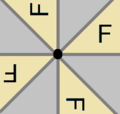 Cyclic symmetry 4
 -
 United States Bicentennial star 1976 (geometry)
 -
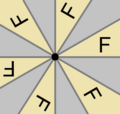 Cyclic symmetry 6
 -
 Shogi
Shogi -
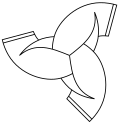 Snoldelev three interlaced horns
 -
 Op art 4 sided spiral tunnel 7
 -
 15 crossings decorative knot


.svg)

.svg)


