Pyrimidinylpiperazine: Difference between revisions
CSV import Tags: mobile edit mobile web edit |
CSV import |
||
| Line 29: | Line 29: | ||
{{Chem-stub}} | {{Chem-stub}} | ||
{{Pharma-stub}} | {{Pharma-stub}} | ||
<gallery> | |||
File:Pyrimidinylpiperazine.png|Pyrimidinylpiperazine | |||
</gallery> | |||
Latest revision as of 21:07, 25 February 2025
Pyrimidinylpiperazine (1-PP) is a chemical compound often found in a variety of pharmaceutical drugs. It is a member of the piperazine family of chemicals, which are used in many industrial and scientific applications.
Chemical Structure[edit]
Pyrimidinylpiperazine is a derivative of piperazine, with a pyrimidine ring attached to one of the nitrogen atoms in the piperazine ring. This gives it a unique chemical structure that allows it to interact with various biological systems in specific ways.
Pharmaceutical Use[edit]
In the pharmaceutical industry, pyrimidinylpiperazine is often used as a building block in the synthesis of more complex drugs. It is a common component in a variety of medications, including antidepressants, antipsychotics, and anxiolytics.
For example, it is a metabolite of the antidepressant drugs buspirone and gepirone, where it contributes to their pharmacological activity. It is also found in the antipsychotic drug perospirone and the anxiolytic drug tandospirone.
Pharmacology[edit]
The pharmacological activity of pyrimidinylpiperazine is largely due to its ability to act as an agonist at the 5-HT1A receptor, a type of serotonin receptor. This receptor is involved in a variety of biological processes, including mood regulation, anxiety, and sleep. By activating this receptor, pyrimidinylpiperazine can produce a variety of effects, depending on the specific drug in which it is included.
Safety and Side Effects[edit]
Like all pharmaceutical ingredients, pyrimidinylpiperazine can cause side effects in some individuals. These can vary widely depending on the specific drug in which it is included, but can include nausea, dizziness, and changes in mood. As with any medication, it is important to use drugs containing pyrimidinylpiperazine under the supervision of a healthcare professional.
See Also[edit]


-
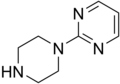 Pyrimidinylpiperazine

