Bignay wine: Difference between revisions
CSV import |
CSV import |
||
| Line 29: | Line 29: | ||
{{wine-stub}} | {{wine-stub}} | ||
{{food-stub}} | {{food-stub}} | ||
<gallery> | |||
File:Bugnay_wine.jpg|Bugnay wine | |||
File:Bignay_Ripe_Fruit.jpg|Bignay ripe fruit | |||
</gallery> | |||
Latest revision as of 11:34, 25 February 2025
Bignay Wine is a type of wine produced from the Bignay fruit, a small, red berry native to Southeast Asia, particularly the Philippines. The Bignay tree, scientifically known as Antidesma bunius, is a tropical plant that produces clusters of small, edible berries. These berries are harvested and fermented to produce Bignay wine, a unique beverage with a distinct, fruity flavor.
History[edit]
The production of Bignay wine has a long history in the Philippines, where the Bignay tree is commonly found. The practice of fermenting Bignay berries into wine is believed to have originated from the indigenous people of the Philippines, who have been using the Bignay fruit for various culinary and medicinal purposes for centuries.
Production[edit]
The process of making Bignay wine involves several steps. First, the Bignay berries are harvested and cleaned. They are then crushed to extract the juice, which is then fermented in a controlled environment. The fermentation process typically takes several weeks, during which the sugars in the Bignay juice are converted into alcohol by yeast. After fermentation, the wine is filtered and aged before it is bottled and sold.
Taste and Pairing[edit]
Bignay wine is known for its unique, fruity flavor, which is often described as a combination of tart and sweet. It has a deep red color, similar to that of the Bignay berries from which it is made. Bignay wine pairs well with a variety of foods, particularly those that are spicy or rich in flavor. It is often served chilled.
Health Benefits[edit]
Bignay wine is rich in antioxidants, particularly anthocyanins, which are known for their health benefits. These antioxidants can help protect the body against damage from free radicals, potentially reducing the risk of chronic diseases such as heart disease and cancer.
See Also[edit]


-
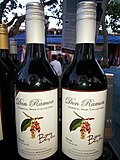 Bugnay wine
 -
 Bignay ripe fruit


