Marine pollution: Difference between revisions
CSV import |
CSV import |
||
| Line 41: | Line 41: | ||
[[Category:Water pollution]] | [[Category:Water pollution]] | ||
{{Environment-stub}} | {{Environment-stub}} | ||
== Marine_pollution == | |||
<gallery> | |||
File:Obvious_water_pollution.jpeg|Obvious water pollution | |||
File:Rio_tinto_river_CarolStoker_NASA_Ames_Research_Center.jpg|Rio tinto river Carol Stoker NASA Ames Research Center | |||
File:Ship_pumping_ballast_water.jpg|Ship pumping ballast water | |||
File:Barbadosdustgraph.gif|Barbados dust graph | |||
File:Caribbean_Jetsam.jpg|Caribbean Jetsam | |||
File:Polluted_Beach.jpg|Polluted Beach | |||
File:The_breakdown_of_a_plastic_bottle_into_smaller_fragments,_eventually_ending_up_as_micro-_and_nano-plastics.png|The breakdown of a plastic bottle into smaller fragments, eventually ending up as micro- and nano-plastics | |||
File:Maldives_-_Kurumba_Island.jpg|Maldives - Kurumba Island | |||
</gallery> | |||
Latest revision as of 23:55, 24 February 2025
Marine pollution refers to the harmful effects caused by the entry of chemicals, particles, industrial, agricultural and residential waste, noise, or the spread of invasive organisms into the ocean. Most sources of marine pollution are land-based. The pollution often comes from nonpoint sources such as agricultural runoff, wind-blown debris, and dust.
Sources of Marine Pollution[edit]
Marine pollution occurs when harmful, or potentially harmful, effects result from the entry into the ocean of chemicals, particles, industrial, agricultural and residential waste, noise, or the spread of invasive organisms. Eighty percent of marine pollution comes from land.
Land-based Sources[edit]
The primary sources of marine pollution are land-based. These include agricultural runoff, wind-blown debris, and dust. Agricultural runoff often contains pesticides, fertilizers, and nutrients that can cause eutrophication, leading to harmful algal blooms and oxygen depletion in water bodies.
Sea-based Sources[edit]
Sea-based sources of marine pollution include oil spills, waste disposal, and routine shipping operations. Oil spills are a well-known source of marine pollution, but they comprise only a small percentage of total marine pollution.
Effects of Marine Pollution[edit]
Marine pollution has a wide range of negative effects on the marine ecosystem and the organisms that live within it. These effects can include the death of marine life, disruptions to marine food chains, and the alteration of marine habitats.
Effects on Marine Life[edit]
Marine pollution can have serious impacts on both marine life and the communities that depend on it. For example, oil spills often kill marine life and damage the marine environment. Plastic debris can choke or starve marine wildlife.
Effects on Human Health[edit]
Marine pollution can also have significant impacts on human health. For example, harmful algal blooms, which can be caused by the input of nutrients from agricultural runoff, can produce toxins that are harmful to humans and marine life.
Prevention and Control[edit]
Preventing and controlling marine pollution requires a comprehensive approach that includes the regulation of sources of pollution, the development of pollution prevention and control measures, and the restoration of polluted marine environments.
See Also[edit]

This article is a environment-related stub. You can help WikiMD by expanding it!
Marine_pollution[edit]
-
 Obvious water pollution
 -
 Rio tinto river Carol Stoker NASA Ames Research Center
 -
 Ship pumping ballast water
 -
 Barbados dust graph
 -
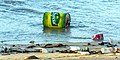 Caribbean Jetsam
 -
 Polluted Beach
 -
 The breakdown of a plastic bottle into smaller fragments, eventually ending up as micro- and nano-plastics
 -
 Maldives - Kurumba Island


