S-Methylmethionine: Difference between revisions
CSV import Tags: mobile edit mobile web edit |
CSV import Tags: mobile edit mobile web edit |
||
| Line 28: | Line 28: | ||
{{biochemistry-stub}} | {{biochemistry-stub}} | ||
{{medicine-stub}} | {{medicine-stub}} | ||
<gallery> | |||
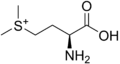
File:Methylmethionine.png|Methylmethionine | |||
</gallery> | |||
Latest revision as of 21:38, 23 February 2025
S-Methylmethionine (also known as Vitamin U) is a derivative of methionine which is found in various plant species. It was first isolated in 1949 by Garnett and co-workers from cabbage juice, where it was shown to have a protective effect on peptic ulcers in humans.
Chemistry[edit]
S-Methylmethionine is a quaternary ammonium salt that is structurally similar to the amino acid methionine, except that the alpha-hydrogen is replaced by a methyl group. It is synthesized in plants from methionine and S-adenosyl methionine (SAM) via the Yang cycle.
Biological role[edit]
In plants, S-Methylmethionine acts as a methyl donor in a variety of methylation reactions. It is also involved in the synthesis of ethylene, a plant hormone that regulates growth and development.
In humans, S-Methylmethionine has been shown to have a protective effect on the gastrointestinal tract, particularly in the prevention and treatment of peptic ulcers. However, its exact mechanism of action is still not fully understood.
Sources[edit]
S-Methylmethionine is found in a variety of plant species, including cabbage, spinach, and alfalfa. It is also available as a dietary supplement.
Safety[edit]
S-Methylmethionine is generally considered safe when consumed in amounts typically found in food. However, excessive intake may cause mild gastrointestinal symptoms such as nausea and diarrhea.
See also[edit]
.svg)
This article is a biochemistry stub. You can help WikiMD by expanding it!

-
 Methylmethionine

