Investment: Difference between revisions
CSV import Tags: mobile edit mobile web edit |
CSV import Tags: mobile edit mobile web edit |
||
| (2 intermediate revisions by the same user not shown) | |||
| Line 1: | Line 1: | ||
{{short description|Overview of investment concepts and types}} | |||
{{Use dmy dates|date=October 2023}} | |||
'''Investment''' is the allocation of resources, usually money, in order to generate income or profit. It involves the purchase of goods that are not consumed today but are used in the future to create wealth. In finance, an investment is a monetary asset purchased with the idea that the asset will provide income in the future or appreciate and be sold at a higher price. | |||
==Types of Investment== | |||
[[File:WikiGraphic.PNG|thumb|right|300px|Diagram illustrating different types of investments.]] | |||
Investments can be broadly categorized into several types, each with its own characteristics and risk profiles. The main types include: | |||
===Stocks=== | |||
[[Stocks]] represent ownership in a company and constitute a claim on part of the company’s assets and earnings. There are two main types of stock: common and preferred. Common stock usually entitles the owner to vote at shareholders' meetings and to receive dividends. | |||
===Bonds=== | |||
[[Bonds]] are fixed income instruments that represent a loan made by an investor to a borrower. Bonds are used by companies, municipalities, states, and sovereign governments to finance projects and operations. Owners of bonds are debtholders, or creditors, of the issuer. | |||
===Real Estate=== | |||
[[Real estate]] investment involves the purchase, ownership, management, rental, and/or sale of real estate for profit. Real estate is an asset form with limited liquidity relative to other investments. | |||
===Mutual Funds=== | |||
[[Mutual funds]] are investment programs funded by shareholders that trade in diversified holdings and are professionally managed. They offer investors a way to invest in a diversified portfolio of assets. | |||
===Commodities=== | |||
[[Commodities]] are basic goods used in commerce that are interchangeable with other goods of the same type. Investors can buy physical commodities like gold or oil, or invest in commodity futures contracts. | |||
==Investment Strategies== | ==Investment Strategies== | ||
[[File:WikiGraphic.PNG|thumb|left|300px|Illustration of various investment strategies.]] | |||
Investment strategies are plans designed to help individual investors achieve their financial and investment goals. Some common strategies include: | |||
===Value Investing=== | |||
[[Value investing]] involves picking stocks that appear to be trading for less than their intrinsic or book value. Value investors actively seek stocks they believe the market has undervalued. | |||
===Growth Investing=== | |||
[[Growth investing]] focuses on capital appreciation. Growth investors look for companies that exhibit signs of above-average growth, even if the share price appears expensive in terms of metrics such as price-to-earnings or price-to-book ratios. | |||
===Income Investing=== | |||
[[Income investing]] is an investment strategy that is centered around building an investment portfolio specifically structured to generate regular income. This can be achieved through dividends, interest payments, or other income streams. | |||
===Index Investing=== | |||
[[Index investing]] is a passive strategy that attempts to replicate the performance of a broad market index, such as the S&P 500. This strategy is based on the efficient market hypothesis, which states that it is difficult to outperform the market consistently. | |||
== | ==Risk and Return== | ||
Investment risk is the possibility of losing some or all of the original investment. Different types of investments carry different levels of risk. Generally, the higher the potential return, the higher the risk. Investors must balance their desire for higher returns with their ability to tolerate risk. | |||
== | ==Related pages== | ||
* [[Finance]] | * [[Finance]] | ||
* [[Economics]] | * [[Economics]] | ||
* [[Portfolio (finance)]] | * [[Portfolio (finance)]] | ||
* [[Asset allocation]] | |||
* [[Risk management]] | |||
[[Category:Investment]] | [[Category:Investment]] | ||
<gallery> | |||
File:WikiGraphic.PNG|WikiGraphic | |||
</gallery> | |||
Latest revision as of 21:30, 23 February 2025
Overview of investment concepts and types
Investment is the allocation of resources, usually money, in order to generate income or profit. It involves the purchase of goods that are not consumed today but are used in the future to create wealth. In finance, an investment is a monetary asset purchased with the idea that the asset will provide income in the future or appreciate and be sold at a higher price.
Types of Investment[edit]

Investments can be broadly categorized into several types, each with its own characteristics and risk profiles. The main types include:
Stocks[edit]
Stocks represent ownership in a company and constitute a claim on part of the company’s assets and earnings. There are two main types of stock: common and preferred. Common stock usually entitles the owner to vote at shareholders' meetings and to receive dividends.
Bonds[edit]
Bonds are fixed income instruments that represent a loan made by an investor to a borrower. Bonds are used by companies, municipalities, states, and sovereign governments to finance projects and operations. Owners of bonds are debtholders, or creditors, of the issuer.
Real Estate[edit]
Real estate investment involves the purchase, ownership, management, rental, and/or sale of real estate for profit. Real estate is an asset form with limited liquidity relative to other investments.
Mutual Funds[edit]
Mutual funds are investment programs funded by shareholders that trade in diversified holdings and are professionally managed. They offer investors a way to invest in a diversified portfolio of assets.
Commodities[edit]
Commodities are basic goods used in commerce that are interchangeable with other goods of the same type. Investors can buy physical commodities like gold or oil, or invest in commodity futures contracts.
Investment Strategies[edit]
Investment strategies are plans designed to help individual investors achieve their financial and investment goals. Some common strategies include:
Value Investing[edit]
Value investing involves picking stocks that appear to be trading for less than their intrinsic or book value. Value investors actively seek stocks they believe the market has undervalued.
Growth Investing[edit]
Growth investing focuses on capital appreciation. Growth investors look for companies that exhibit signs of above-average growth, even if the share price appears expensive in terms of metrics such as price-to-earnings or price-to-book ratios.
Income Investing[edit]
Income investing is an investment strategy that is centered around building an investment portfolio specifically structured to generate regular income. This can be achieved through dividends, interest payments, or other income streams.
Index Investing[edit]
Index investing is a passive strategy that attempts to replicate the performance of a broad market index, such as the S&P 500. This strategy is based on the efficient market hypothesis, which states that it is difficult to outperform the market consistently.
Risk and Return[edit]
Investment risk is the possibility of losing some or all of the original investment. Different types of investments carry different levels of risk. Generally, the higher the potential return, the higher the risk. Investors must balance their desire for higher returns with their ability to tolerate risk.
Related pages[edit]
-
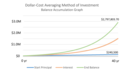 WikiGraphic
