Guam: Difference between revisions
CSV import |
No edit summary |
||
| Line 32: | Line 32: | ||
{{dictionary-stub1}} | {{dictionary-stub1}} | ||
<gallery> | <gallery> | ||
File:Chronological_dispersal_of_Austronesian_people_across_the_Pacific.svg|Chronological dispersal of Austronesian people across the Pacific | File:Chronological_dispersal_of_Austronesian_people_across_the_Pacific.svg|Chronological dispersal of Austronesian people across the Pacific | ||
File:Reception_of_the_Manila_Galleon_by_the_Chamorro_in_the_Ladrones_Islands,_ca._1590.jpg|Reception of the Manila Galleon by the Chamorro in the Ladrones Islands, ca. 1590 | File:Reception_of_the_Manila_Galleon_by_the_Chamorro_in_the_Ladrones_Islands,_ca._1590.jpg|Reception of the Manila Galleon by the Chamorro in the Ladrones Islands, ca. 1590 | ||
Latest revision as of 21:13, 23 February 2025
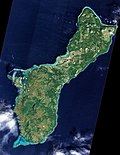
Guam is an unincorporated and organized territory of the United States located in the western Pacific Ocean. It is the largest and southernmost of the Mariana Islands chain. The capital city of Guam is Hagåtña, and the most populous city is Dededo.
History[edit]
Guam's history is rich and complex, with influences from various cultures and nations. The island was first populated around 4,000 years ago by the Chamorro people, who are indigenous to Guam. The first European to visit the island was Ferdinand Magellan in 1521, who was sailing for Spain. Guam was colonized by Spain in 1668 with settlers, including Diego Luis de San Vitores, a Catholic Jesuit missionary.
Geography[edit]
Guam is the largest island in Micronesia and it is the southernmost island in the Mariana Islands archipelago. The island is 30 miles long and 9 miles wide. The highest point is Mount Lamlam at an elevation of 1,332 feet.
Climate[edit]
Guam has a tropical rainforest climate, with an average temperature of 86 degrees Fahrenheit year-round. The island experiences two seasons: the dry season from January to May, and the rainy season from June to December.
Demographics[edit]
As of 2020, the population of Guam was approximately 168,000. The majority of the population are the indigenous Chamorro people, followed by Filipinos, and a small percentage of other Pacific Islanders, Asians, and Caucasians.
Economy[edit]
The economy of Guam is largely supported by tourism, particularly from Japan, Korea, and the United States. The military also plays a significant role in the economy, with a large U.S. military presence on the island.
Health[edit]
Healthcare in Guam is provided by the Guam Memorial Hospital Authority and various private clinics. The island also faces unique health challenges due to its remote location and limited resources.
Education[edit]
Education in Guam is provided by the Guam Department of Education, which operates public schools on the island. There are also several private schools and the University of Guam provides higher education opportunities.
Culture[edit]
Guam's culture is a fusion of its indigenous Chamorro heritage, Spanish influences from its colonial period, and American influences from its current status as a U.S. territory.
 | |
|---|---|
 |
 |
-
 Chronological dispersal of Austronesian people across the Pacific
 -
 Reception of the Manila Galleon by the Chamorro in the Ladrones Islands, ca. 1590
 -
 Main street of Agana or Hagåtña, Guam (1899-1900)
 -
 3rd Battalion 3rd Marines Agana
 -
 Guam ali 2011364 lrg
 -
 Ritidian Beach - Guam NWR
 -
 Ficus prolixa interwoven canopy. 1000 Steps hiking trail, Pagat, Guam
 -
 20140402-APHIS-UNK-0004 (13592983734)
 -
 Fish and coral in Tumon Bay Marine Preserve, Guam
 -
 Another GUAM sign in front the Guam Museum (49332191732)


.jpg)


.jpg)

.jpg)
