Polar bear: Difference between revisions
CSV import |
CSV import |
||
| Line 36: | Line 36: | ||
{{biology-stub}} | {{biology-stub}} | ||
<gallery> | |||
File:Polar_Bear_-_Alaska_(cropped).jpg|Polar Bear - Alaska | |||
File:polarbrown-1.jpg|Polar Brown | |||
File:Description_iconographique_comparée_du_squelette_et_du_système_dentaire_des_mammifères_récents_et_fossiles_(Ursus_maritimus_skeleton).jpg|Ursus maritimus skeleton | |||
File:Ursus_maritimus_02_MWNH_420.JPG|Ursus maritimus | |||
File:Polar_Bear_AdF.jpg|Polar Bear | |||
File:Polar_bear_subpopulation_map.svg|Polar bear subpopulation map | |||
File:Mother_cubs.JPG|Mother and cubs | |||
File:Play_fight_of_polar_bears_edit_1.ogv|Play fight of polar bears | |||
File:Polar_bear_(Ursus_maritimus)_with_its_prey.jpg|Polar bear with its prey | |||
File:Polar_Bear_ANWR_10.jpg|Polar Bear ANWR | |||
File:Встреча_2.jpg|Встреча | |||
File:Polar_bear_cubs_in_the_snow.jpg|Polar bear cubs in the snow | |||
</gallery> | |||
Latest revision as of 21:06, 23 February 2025
Polar bear
The Polar bear (Ursus maritimus) is a hypercarnivorous bear whose native range lies largely within the Arctic Circle, encompassing the Arctic Ocean, its surrounding seas and surrounding land masses. It is the largest extant bear species, as well as the largest extant predatory carnivore. A boar (adult male) weighs around 350–700 kg (770–1,540 lb), while a sow (adult female) is about half that size.
Taxonomy[edit]
The polar bear was previously considered to be in its own genus, Thalarctos. However, evidence of hybrids between polar bears and brown bears, and of the recent evolutionary divergence of the two species, does not support the establishment of this separate genus, and the accepted scientific name is now Ursus maritimus, meaning "maritime bear".
Characteristics[edit]
Polar bears are distinguished by their white fur, which helps them blend into their icy surroundings. They have a thick layer of body fat, which helps them stay warm in the cold Arctic weather. Their paws are wide and large, helping them to distribute their weight on thin ice and snow, and they are excellent swimmers.
Habitat and distribution[edit]
Polar bears are found throughout the Arctic, in countries such as Canada, Russia, Greenland, Norway and the United States (specifically Alaska). They are most commonly found along the coasts and on islands, where they can hunt their primary prey, seals.
Conservation status[edit]
The polar bear is classified as a vulnerable species by the International Union for Conservation of Nature (IUCN), with eight of the nineteen polar bear subpopulations in decline. For decades, large scale hunting raised international concern for the future of the species but populations rebounded after controls and quotas began to take effect.
See also[edit]
| Polar bears | ||||||||||
|---|---|---|---|---|---|---|---|---|---|---|
This polar bear related article is a stub.
|
| Bears | ||||||||||
|---|---|---|---|---|---|---|---|---|---|---|
|
| Arctic | ||||||||||
|---|---|---|---|---|---|---|---|---|---|---|
|
| Mammals of North America | ||||||||
|---|---|---|---|---|---|---|---|---|
This Mammals of North America related article is a stub.
|
| Mammals of Europe | ||||||||||
|---|---|---|---|---|---|---|---|---|---|---|
This Mammals of Europe related article is a stub.
|

-
 Polar Bear - Alaska
 -
 Polar Brown
 -
 Ursus maritimus skeleton
 -
 Ursus maritimus
 -
 Polar Bear
 -
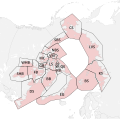 Polar bear subpopulation map
 -
 Mother and cubs
 -
 Play fight of polar bears
 -
 Polar bear with its prey
 -
 Polar Bear ANWR
 -
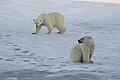 Встреча
 -
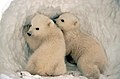 Polar bear cubs in the snow
.jpg)

.jpg)


_with_its_prey.jpg)


