Behavioral ecology: Difference between revisions
CSV import |
CSV import |
||
| Line 34: | Line 34: | ||
[[Category:Evolutionary Biology]] | [[Category:Evolutionary Biology]] | ||
{{biology-stub}} | {{biology-stub}} | ||
== Behavioral_ecology == | |||
<gallery> | |||
File:Aptenodytes_forsteri_-Snow_Hill_Island,_Antarctica_-juvenile-8.jpg|Aptenodytes forsteri juvenile | |||
File:V-formation.jpg|V-formation | |||
File:Bee_dance.svg|Bee dance | |||
File:Loxodonta_africana_crossing_the_Zambesi.jpg|Loxodonta africana crossing the Zambesi | |||
File:BennyTrapp_Hyla_intermedia_Italien.jpg|Hyla intermedia | |||
File:Stotting_gazelle.jpg|Stotting gazelle | |||
File:RanaArvalisBlueMale3.jpg|Rana arvalis blue male | |||
File:Panorpa_communis_V.jpg|Panorpa communis | |||
File:Gallus_gallus_female_-_Kaeng_Krachan.jpg|Gallus gallus female | |||
File:Great_Tit_(Parus_major)_(2).jpg|Great Tit (Parus major) | |||
File:Blackbird_chicks_in_nest.JPG|Blackbird chicks in nest | |||
File:Galápagos_fur_seals_(4229111296).jpg|Galápagos fur seals | |||
</gallery> | |||
Latest revision as of 21:02, 23 February 2025
Behavioral Ecology is a field of study that explores the evolutionary basis for animal behavior due to ecological pressures. It attempts to understand and explain how the natural and social environment influences behavior across a wide range of species.
Definition[edit]
Behavioral ecology is an interdisciplinary science that combines elements of biology, ecology, ethology, evolutionary biology, and natural selection. It is concerned with the adaptive value of behavior, and how behavior helps an organism to survive and reproduce.
History[edit]
The term "behavioral ecology" was first used in the late 1970s, following the publication of a book by the same name by John Krebs and Nicholas Davies. The field has since grown and diversified, with many researchers contributing to our understanding of animal behavior.
Key Concepts[edit]
Behavioral ecology is based on several key concepts, including:
- Optimal Foraging Theory: This theory suggests that animals will maximize their food intake while minimizing their energy expenditure.
- Life History Theory: This theory examines how an organism's life history traits (such as age at first reproduction, number of offspring, and lifespan) are influenced by natural selection.
- Game Theory: This mathematical model is used to predict the outcome of interactions between individuals, where the success of one individual's strategy depends on the strategies of others.
Research Methods[edit]
Research in behavioral ecology often involves field observations, laboratory experiments, and mathematical modeling. Researchers may study a single species in depth, or compare behaviors across a range of species.
Applications[edit]
The findings of behavioral ecology have applications in many areas, including conservation biology, wildlife management, and animal welfare. For example, understanding the behavior of a species can help in designing effective conservation strategies.
See Also[edit]
References[edit]
<references />

Behavioral_ecology[edit]
-
 Aptenodytes forsteri juvenile
 -
 V-formation
 -
 Bee dance
 -
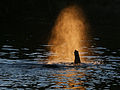 Loxodonta africana crossing the Zambesi
 -
 Hyla intermedia
 -
 Stotting gazelle
 -
 Rana arvalis blue male
 -
 Panorpa communis
 -
 Gallus gallus female
 -
 Great Tit (Parus major)
 -
 Blackbird chicks in nest
 -
 Galápagos fur seals


_(2).jpg)

.jpg)
