Cytopathology: Difference between revisions
CSV import |
|||
| (One intermediate revision by the same user not shown) | |||
| Line 36: | Line 36: | ||
File:Serous carcinoma 2c - cytology.gif|Serous carcinoma cytology | File:Serous carcinoma 2c - cytology.gif|Serous carcinoma cytology | ||
File:Pap stain of adenocarcinoma in peritoneal fluid.png|Pap stain of adenocarcinoma in peritoneal fluid | File:Pap stain of adenocarcinoma in peritoneal fluid.png|Pap stain of adenocarcinoma in peritoneal fluid | ||
File:Low-grade squamous intraepithelial lesion.jpg|Low-grade squamous intraepithelial lesion | File:Low-grade squamous intraepithelial lesion.jpg|Low-grade squamous intraepithelial lesion | ||
File:Journal.pone.0026395.g001 cervical cytology brushes.png|Cervical cytology brushes | File:Journal.pone.0026395.g001 cervical cytology brushes.png|Cervical cytology brushes | ||
File:Pap smear of a monocyte with nuclear smearing artifact.jpg|Pap smear of a monocyte with nuclear smearing artifact | File:Pap smear of a monocyte with nuclear smearing artifact.jpg|Pap smear of a monocyte with nuclear smearing artifact | ||
</gallery> | </gallery> | ||
Latest revision as of 01:44, 20 February 2025
Cytopathology is a branch of pathology that studies and diagnoses diseases on the cellular level. The term "cytopathology" is derived from the Greek words kytos meaning "container" or "cell" and pathos meaning "disease". Cytopathology is used to investigate diseases by examining cell samples from various body sites. This discipline plays a crucial role in diagnosing cancers, infectious diseases, and inflammatory conditions.
Overview[edit]
Cytopathology involves the examination of cells extracted from tissues for signs of disease. Unlike histopathology, which studies whole tissues, cytopathology focuses on the morphological aspects of cells. The primary method used in cytopathology is the Papanicolaou test (also known as the Pap test or smear), which is widely used for the detection of cervical cancer and precancerous conditions. Other techniques include fine-needle aspiration (FNA), in which cells are extracted using a thin needle, and exfoliative cytology, where cells are shed into bodily fluids and collected.
Techniques[edit]
- Papanicolaou Test: A screening tool for the detection of cervical cancer, precancerous lesions, and other cytologic diseases of the female reproductive tract.
- Fine-Needle Aspiration (FNA): A diagnostic procedure used to investigate lumps or masses. In this technique, a thin needle is inserted into an area of abnormal-appearing tissue or body fluid.
- Exfoliative Cytology: Involves the examination of cells that are shed naturally from the body or obtained through rinsing or brushing a lesion. It is commonly used for the diagnosis of bladder, lung, and esophageal cancers.
Applications[edit]
Cytopathology is widely used in the diagnosis of cancer, including breast cancer, thyroid cancer, and prostate cancer, among others. It is also employed in the diagnosis of infectious diseases and inflammatory conditions. The technique offers several advantages, including minimal invasiveness, rapid results, and cost-effectiveness. However, its accuracy can be affected by sampling error and the experience of the cytopathologist.
Challenges and Limitations[edit]
One of the main challenges in cytopathology is the potential for sampling error, as the technique relies on the examination of a small number of cells. Additionally, the interpretation of cell samples requires a high degree of expertise and experience, and there can be variability in diagnosis among different cytopathologists.
Future Directions[edit]
Advancements in molecular biology and genetics are increasingly being integrated into cytopathological practices. Techniques such as fluorescence in situ hybridization (FISH) and polymerase chain reaction (PCR) are being used to detect specific genetic abnormalities in cells, allowing for more precise diagnoses and personalized treatment plans.
See Also[edit]
References[edit]
<references/>

Cytopathology[edit]
-
 Serous carcinoma cytology
 -
 Pap stain of adenocarcinoma in peritoneal fluid
 -
 Low-grade squamous intraepithelial lesion
 -
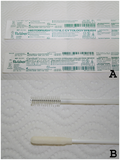 Cervical cytology brushes
 -
 Pap smear of a monocyte with nuclear smearing artifact


