Matsutake: Difference between revisions
CSV import Tags: mobile edit mobile web edit |
CSV import |
||
| Line 25: | Line 25: | ||
[[Category:Edible fungi]] | [[Category:Edible fungi]] | ||
{{food-stub}} | {{food-stub}} | ||
<gallery> | |||
File:Matsutake.jpg|Matsutake | |||
File:W matutake4111.jpg|Matsutake | |||
File:Tricholoma matsutake - National Museum of Nature and Science, Tokyo - DSC06852.JPG|Matsutake | |||
File:豊丘村産松茸.jpg|Matsutake | |||
File:松茸 (6285432404).jpg|Matsutake | |||
File:Fresh matsutake.jpg|Fresh matsutake | |||
File:Matsutakegari.jpg|Matsutake | |||
File:Matsutake gohan (2016-11-29) 01.jpg|Matsutake gohan | |||
File:Songi-jorim.jpg|Songi-jorim | |||
File:Jisaku Kaiseki Ryori 08.jpg|Kaiseki Ryori | |||
File:Dried matsutake mushrooms.jpg|Dried matsutake mushrooms | |||
File:Sesame oil with matsutake mushrooms.jpg|Sesame oil with matsutake mushrooms | |||
</gallery> | |||
Latest revision as of 01:40, 20 February 2025
Matsutake (Tricholoma matsutake) is a type of mushroom that is highly prized in Japanese cuisine. It is known for its distinct spicy-aromatic odor.
Description[edit]
Matsutake mushrooms are characterized by their large size, white color, and distinctive aroma. They have a firm, meaty texture and a unique, spicy flavor that is highly valued in many cuisines, particularly in Japan. The mushrooms grow in coniferous forests and are often found in association with the roots of pine trees.
Distribution and habitat[edit]
Matsutake mushrooms are native to Japan, China, Korea, and other parts of East Asia. They are also found in North America, particularly in the Pacific Northwest and Northern California. They typically grow in pine forests and prefer cool, moist conditions.
Culinary uses[edit]
In Japanese cuisine, matsutake mushrooms are often used in soups and stews, as well as in grilled dishes. They are also a popular ingredient in sushi. Due to their strong flavor, they are typically used sparingly and are considered a delicacy.
Economic importance[edit]
Matsutake mushrooms are one of the most expensive mushrooms in the world, with prices often exceeding $1,000 per kilogram. Their high price is due to their rarity and the difficulty of harvesting them, as they often grow in hard-to-reach places and are typically harvested by hand.
Conservation[edit]
Due to overharvesting and habitat loss, matsutake mushrooms are becoming increasingly rare in the wild. Efforts are being made to conserve their habitats and to cultivate the mushrooms in a sustainable manner.
See also[edit]

-
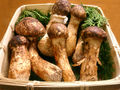 Matsutake
 -
 Matsutake
 -
 Matsutake
 -
 Matsutake
 -
 Matsutake
 -
 Fresh matsutake
 -
 Matsutake
 -
 Matsutake gohan
 -
 Songi-jorim
 -
 Kaiseki Ryori
 -
 Dried matsutake mushrooms
 -
 Sesame oil with matsutake mushrooms


.jpg)


_01.jpg)


