Moulage: Difference between revisions
CSV import |
CSV import |
||
| (3 intermediate revisions by the same user not shown) | |||
| Line 1: | Line 1: | ||
'''Moulage''' is the art of applying mock injuries for the purpose of training medical and emergency response teams. It is a technique used to simulate realistic injuries, wounds, and other medical conditions to enhance the training experience for medical students, emergency medical technicians (EMTs), and other healthcare professionals. | '''Moulage''' is the art of applying mock injuries for the purpose of training medical and emergency response teams. It is a technique used to simulate realistic injuries, wounds, and other medical conditions to enhance the training experience for medical students, emergency medical technicians (EMTs), and other healthcare professionals. | ||
| Line 48: | Line 40: | ||
* [[Medical education]] | * [[Medical education]] | ||
* [[Emergency medical services]] | * [[Emergency medical services]] | ||
==External Links== | ==External Links== | ||
* [ | * [https://www.moulage.com Moulage Techniques and Tutorials] | ||
* [ | * [https://www.ssih.org Society for Simulation in Healthcare] | ||
{{nt}} | |||
[[Category:Medical education]] | [[Category:Medical education]] | ||
[[Category:Emergency medicine]] | [[Category:Emergency medicine]] | ||
[[Category:Simulation]] | [[Category:Simulation]] | ||
<gallery> | |||
File:Wachsmoulage einer Gumma bei Siphilis.JPG|Moulage | |||
File:Moulage.jpg|Moulage | |||
File:Moulage dummy.jpg|Moulage | |||
File:Anatomical Moulages (Torso).JPG|Moulage | |||
File:Exploded bullet hit squibs on an actor wearing scrubs (cropped).jpg|Moulage | |||
File:Facial graze and lacerations.jpg|Moulage | |||
</gallery> | |||
Latest revision as of 01:30, 20 February 2025
Moulage is the art of applying mock injuries for the purpose of training medical and emergency response teams. It is a technique used to simulate realistic injuries, wounds, and other medical conditions to enhance the training experience for medical students, emergency medical technicians (EMTs), and other healthcare professionals.
History[edit]
The use of moulage dates back to the early 19th century when it was first used in military medicine to train soldiers and medics. The term "moulage" is derived from the French word for "mold" or "casting," reflecting the early techniques of creating realistic replicas of injuries using wax and other materials.
Techniques[edit]
Moulage involves a variety of techniques to create realistic simulations of injuries. These techniques include:
- Wax Moulage: Historically, wax was used to create lifelike replicas of wounds and injuries. This technique involves sculpting wax to mimic the appearance of skin and tissue damage.
- Silicone Moulage: Modern moulage often uses silicone due to its flexibility and realistic texture. Silicone can be colored and shaped to create a wide range of injuries.
- Makeup and Paint: Special effects makeup and paint are used to add color and detail to moulage, enhancing the realism of the simulation.
- Prosthetics: Pre-made prosthetic pieces can be applied to simulate complex injuries such as compound fractures or burns.
Applications[edit]
Moulage is used in various fields of medical and emergency training, including:
- Medical education: Moulage is used in medical schools to teach students about wound assessment, diagnosis, and treatment.
- Emergency response training: EMTs and paramedics use moulage to practice responding to traumatic injuries in a controlled environment.
- Disaster drills: Moulage is used in large-scale disaster simulations to train responders in mass casualty scenarios.
Benefits[edit]
The use of moulage in training offers several benefits:
- Realism: Moulage provides a realistic representation of injuries, helping trainees to better understand the appearance and complexity of different medical conditions.
- Hands-on experience: Trainees gain practical experience in assessing and treating injuries, improving their skills and confidence.
- Enhanced learning: The realistic nature of moulage helps reinforce theoretical knowledge through practical application.
Challenges[edit]
While moulage is a valuable training tool, it also presents certain challenges:
- Cost: High-quality moulage materials and prosthetics can be expensive.
- Time: Creating and applying moulage can be time-consuming, requiring skilled technicians.
- Maintenance: Moulage materials need to be maintained and replaced regularly to ensure continued realism.
Future Directions[edit]
Advancements in technology are continually improving the field of moulage. Innovations such as 3D printing and digital simulations are being integrated into traditional moulage techniques to enhance realism and accessibility.
See Also[edit]
External Links[edit]
-
 Moulage
 -
 Moulage
 -
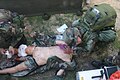 Moulage
 -
 Moulage
 -
 Moulage
 -
 Moulage


.JPG)
.jpg)

