Fresh frozen plasma: Difference between revisions
CSV import |
CSV import |
||
| Line 51: | Line 51: | ||
[[Category:Blood products]] | [[Category:Blood products]] | ||
[[Category:Transfusion medicine]] | [[Category:Transfusion medicine]] | ||
<gallery> | |||
File:FreshFrozenPlasma.JPG|Fresh frozen plasma | |||
File:Warfarin.svg|Warfarin | |||
File:1e7h.jpg|1e7h | |||
</gallery> | |||
Latest revision as of 01:12, 20 February 2025
Fresh Frozen Plasma


Fresh frozen plasma (FFP) is a blood product made from the liquid portion of whole blood. It is used in the treatment of conditions where there is a deficiency of clotting factors or other plasma proteins. FFP is obtained by centrifuging whole blood and freezing the plasma within hours of collection to preserve the clotting factors.
Indications[edit]
FFP is primarily used in the following situations:
- Coagulation factor deficiencies: FFP is used to treat patients with multiple coagulation factor deficiencies, such as those with liver disease or disseminated intravascular coagulation (DIC).
- Warfarin reversal: In cases of severe bleeding or prior to emergency surgery, FFP can be used to reverse the effects of warfarin (an anticoagulant), as it contains vitamin K-dependent clotting factors.
- Massive transfusion protocols: During massive transfusions, FFP is used to replace clotting factors that are lost along with red blood cells.
- Thrombotic thrombocytopenic purpura (TTP): FFP is used as part of plasma exchange therapy in TTP.
Administration[edit]
FFP is administered intravenously. The dosage and rate of infusion depend on the clinical situation and the patient's body weight. It is important to monitor the patient for any adverse reactions during and after the transfusion.
Risks and Complications[edit]
While FFP is generally safe, there are potential risks and complications associated with its use:
- Allergic reactions: Patients may experience mild to severe allergic reactions.
- Transfusion-related acute lung injury (TRALI): A rare but serious complication characterized by acute respiratory distress.
- Infections: Although screened and tested, there is a minimal risk of transmitting infections.
- Volume overload: Especially in patients with heart failure or renal impairment.
Alternatives[edit]
Alternatives to FFP include:
- Prothrombin complex concentrates (PCCs): These are used for rapid reversal of warfarin.
- Recombinant clotting factors: Used in specific factor deficiencies.
- Cryoprecipitate: Contains fibrinogen and is used in certain bleeding disorders.
Also see[edit]
References[edit]
<references group="" responsive="1"></references>
External links[edit]
-
 Fresh frozen plasma
 -
 Warfarin
 -
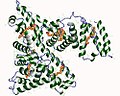 1e7h
1e7h


